Carbon Costing
Carbon through cost
The challenges and opportunities of decarbonisation
 THE minimisation of carbon in our lives is the greatest challenge and opportunity of our time. Whilst sustainability is a broad and all-encompassing arena, carbon and other greenhouse gases (GHG) are clearly a focal point of our attention, given their ability to change humanity’s existence if levels in the atmosphere are not lowered. According to the Climate Change Committee’s Sixth Carbon Budget, the construction industry accounts for approximately 12% of the United Kingdom’s emissions. Therefore, the UK construction industry has a significant role to play in the country’s legislated 2050 net zero target and meeting the Paris Agreement commitment.
The quantity surveyor opportunity
Given this significant task, the burden of decarbonisation lies beyond the sole responsibility of the sustainability and environmental teams in the industry. The entire construction professions have the opportunity to come together and collaborate with their vast skill-sets. Whereby the measurement of carbon, accumulation of data and development of tracking mechanisms are necessary for the identification of ‘carbon hotspots’ and to enhance our understanding and awareness of the pervasiveness of carbon throughout construction phases.
Quantity surveyors possess a unique skill-set that is advantageous to this undertaking. The similarity of cost and carbon is clear. Both items are quantities, in limited amounts, and have an ever-present objective to minimise the total figure. As such, every item necessary for a construction project has a cost and carbon price tag. Quantity surveyors therefore have some of the best placed skill-sets to measure, track and actively drive the low carbon ambition on projects. Furthermore, the management of costs undertaken by quantity surveyors is not only advantageous to measuring carbon but also enables the alignment of low carbon and value for money aims, rather than them existing as competing objectives.
Quantity surveyors have some of the best-placed skill-sets to measure, track and actively drive the low carbon ambition on projects.
Safety culture in recent decades has assimilated, is it safe to build this way? A low carbon focus now asks, does this need to be built? How can it be built better? These questions will inevitably save carbon and it can be done with cost parity and savings given the due attention. The broad engagement that quantity surveyors have throughout a project team will then likely enable the carbon agenda to become more visible with the ability to proactively influence procurement, design, engineering and construction decisions. This ethos is advocated for in PAS 2080: Carbon Management in Infrastructure, which highlights the need for assessments, conveys the level of influence possible over a project’s lifespan (Figure 1), and places emphasis on the necessity to “challenge the status quo to drive low carbon actions” (Figure 2).
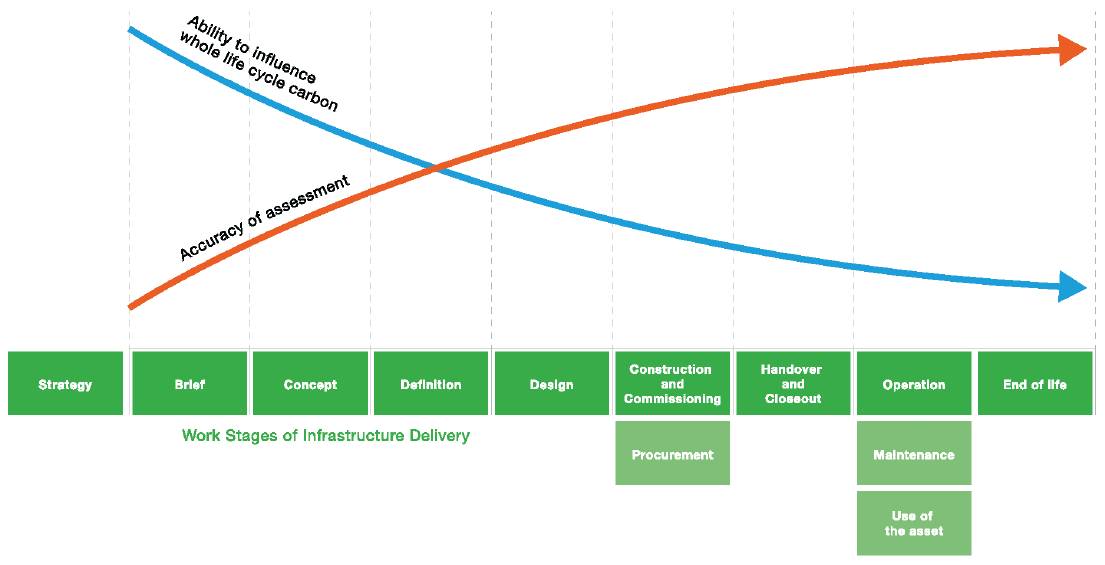 Figure 1: Conceptual diagram to showing ability to influence carbon reduction across the different work stages of infrastructure delivery. ©BSI
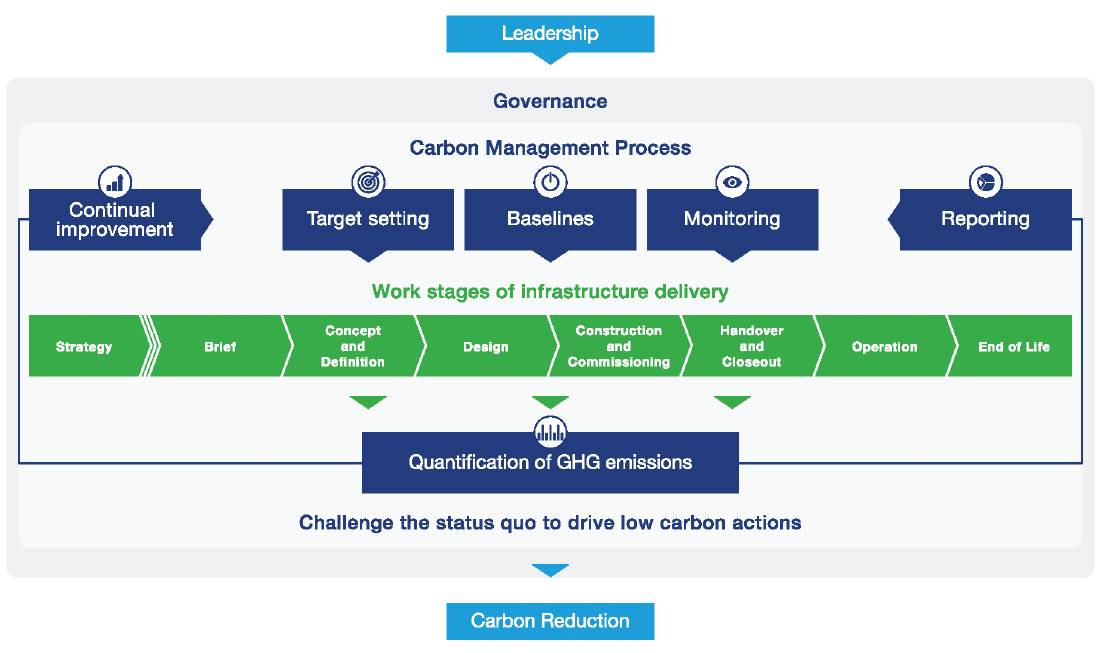 Figure 2: Carbon management process. ©BSI
Cost proxy
An environmental product declaration (EPD) is defined by ISO 14025 as:
“A verified and registered document that communicates transparent and comparable information about the lifecycle environmental impact of products.”
In summary, EPDs enable the carbon emissions associated with a specific product to be specifically calculated. These documents can account for differing lifecycle stages such as production, transportation, installation, use and/or end-of-life. They are valuable documents and are a first step to accurately measuring the embodied carbon of materials throughout their lifecycle. Nonetheless, there are still many EPDs to be created and scope gaps to be filled. This is where cost can act as suitable solution to ensuring a project’s full carbon picture is attained now.
The European Network of Construction Companies for Research and Development (ENCORD) presents a cost-based approach to carbon calculations at a company and project level. Similarly, hybrid input-output or input-output-based methodologies also allow for project-specific costs to be converted into carbon values incorporating or excluding EPD values if unknown. Overall, it is possible for project-specific carbon emissions to be measured through a cost proxy.
A large proportion of the expenditure on projects is already actively managed and approved by quantity surveyors. Given that cost can be used to attain carbon values, there is an enormous resource presented by quantity surveyors which is invaluable for tracking carbon alongside cost on individual projects. It could therefore be ensured that the majority of a project’s carbon expenditure is accounted for at a granular level with minor adaption to current project roles.
There is naturally a caveat that EPDs and process-based carbon calculations are always preferable to a cost proxy, as they are more accurate calculations. However, in the interim, a cost proxy enables detailed project carbon emissions across all scope items to be captured today where it can be used for analysis and enable future improvements.
Carbon budgets
It is likely in the not-too-distant future that projects will have carbon budgets and targets incorporated into project documentation. In particular, public-funded infrastructure projects, where it is feasible to envisage that carbon targets will be aligned with the Climate Change Committee’s carbon budgets for the United Kingdom. HM government’s recently published Construction Playbook states that “authorities should require whole-life carbon assessments” from potential suppliers and that “should cost models (SCM) should be linked to whole-life carbon assessments.” This may present financial implications to an already low-margin industry. The ability to track carbon emissions on projects today will assist with the development of reduction strategies cultivated across the sector to minimise this risk.
Overall, the UK construction industry faces a momentous task of decarbonising by 2050. Yet, decarbonisation also presents an opportunity to design more efficiently, procure more thoughtfully and build with future generations in mind. The tracking and accumulation of carbon data is paramount to developing this understanding and it will require the ongoing collaboration of all industry professionals. Then, by the very nature of their skill-set, quantity surveyors have a unique opportunity to contribute.
Elisabeth McLaughlin MCInstCES PIEMA Associate Quantity Surveyor, Foster + Partners e
mclaughlin@FosterandPartners.com www.fosterandpartners.com
Elizabeth McLaughlin is the CICES Sustainability Lead and a member of the CICES Sustainability Competencies Working Group.
Permission to reproduce extracts from British Standards is granted by BSI Standards Limited (BSI). No other use of this material is permitted. British Standards can be obtained in PDF or hard copy formats from the BSI online shop: www.bsigroup.com/Shop