Airborne sensors help developers protect wildlife habitats
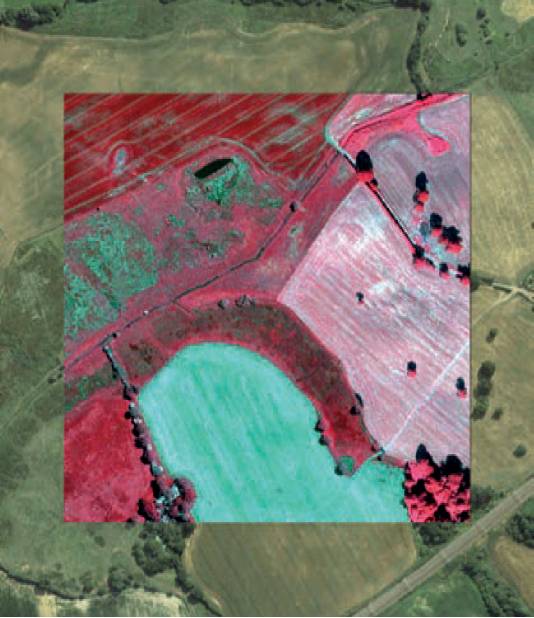
AI technology used in combination with aerial surveying company, Bluesky’s four-band aerial photography, is helping developers contribute to UK government targets to protect wildlife habitats.
It has seen technology company Gentian create computerised workflows that recognise and separate different habitat types remotely and autonomously.
The system helps to identify habitats and protect them on sites earmarked for development.
The Bluesky photography used by Gentian includes simultaneously captured traditional RGB (red green blue) bands combined with the near-infrared (NIR) wavelength to produce false colour or colour infrared images (CIR).
Traditional RGB imagery is useful for picking out distinguishing habitat characteristics, such as tractor marks in arable areas.
CIR photography is a useful way of assessing the health of vegetation as healthy plants reflect more of the NIR wavelength, and therefore appear brighter in the image.
It can also be used as a tool to evaluate water quality as water absorbs the NIR wavelength whilst sediment and suspended particles reflect it.
Using Bluesky’s data, Gentian’s automated habitat classification enables it to comply with biodiversity net gain (BNG) regulations under the Environment Act 2021, which will be a legal requirement for all planning granted in England, with a few exemptions, to deliver at least 10% BNG from November 2023.

Brissie’s mega project takes on the world-first underground mezzanine-level challenge
Australia’s fastest growing city, Brisbane is undertaking a $6.3bn Cross River Rail project affectionately known as ‘Brissie’s mega project’.
Delivered in partnership with three major infrastructure contactors, PULSE, UNITY Alliance, and Hitachi Rail STS, a new 10.2km rail line is being constructed to transform travelling across the whole of South East Queensland.
This includes 5.9km of twin tunnels under the Brisbane River and the city’s central business district, with four new underground stations, as well as two new above-ground stations.
The new line will unlock a bottleneck at the core of the rail network by adding a second inner-city river crossing to the rail network.
Cross River Rail was central to Brisbane’s successful bid to host the 2032 Olympic and Paralympic Games, so the challenge is to complete it in time for the world’s largest sporting event.
Recent updates on the Cross River Rail, has seen the project champion a number of innovative construction methods.
One of its most impressive engineering feats is the world-first method used to install mezzanine levels at their underground stations.
These installations involve placing massive 70-tonne concrete beams in the underground stations.
Metocean survey for Salamander offshore wind farm project supports the UK’s net-zero future
Salamander, a joint venture between Ørsted, Simply Blue Group and Subsea 7, has appointed Fugro to conduct a comprehensive metocean survey for the proposed Salamander offshore wind farm project. Located 35 km off the coast of Peterhead, Scotland, the 100MW project will use innovative floating offshore wind technologies to help Scotland and the UK progress towards a net-zero future.
Scheduled to begin this month, the survey will run for approximately twelve months and gather essential meteorological, oceanographic, and environmental data, such as wave height, wind and current speed. These insights will inform the project’s design, operations, and maintenance strategy, as well as support the planning application process due to be submitted in early 2024.
The wind farm is expected to generate enough green energy to power up to 100,000 Scottish homes.
Designs have been completed for the world’s largest cable-layer vessel
Once developed the world’s largest cablelaying vessel will lay 3,800km of subsea cables for the UK grid from Morocco to southern England. Costing £20bn, it will be twice the size of Prysmian’s Leonardo da Vinci, the world’s current largest vessel. XLCC will build up to three cable factories as well as the vessel to complete the solar and wind energy project with investment coming from energy firm Octopus and the Abu Dhabi National Power company TAQA.
Ten-year multi-million-pound collaboration to accelerate data-centric engineering research impact
The Alan Turing Institute has entered the second phase of its partnership with global safety charity Lloyd’s Register Foundation translating Turing data-centric engineering research into real-world impact. Phase two will develop data science and AI for safety standards, through increased engagement with potential users, across safety domains, and with regulators, such as the transport and energy sectors.
UK government launches Great British Nuclear and modular reactor competition
The Department for Energy Security and Net Zero (DESNZ) has launched Great British Nuclear (GBN). The new government body will manage the delivery of all of the UK’s nuclear projects, including Hinkley Point C and Sizewell C. Alongside the launch announcement, is GBN’s first circa £20bn funding competition to design and build small modular reactor (SMR) nuclear projects, which ‘could result in billions of pounds of public and private sector investment’ in the UK. In addition, a circa £157m grant funding package across the nuclear industry has been unveiled. Grants have been allocated to a variety of projects utilising a wide range of nuclear technologies, including £77.1 into companies engaged in ‘advanced nuclear business development’. For further details on the grant funding, as well as the GBN and the SMR competition, visit https:/tinyurl.com/n3nvt4en.
Green light for major A303 upgrade past Stonehenge
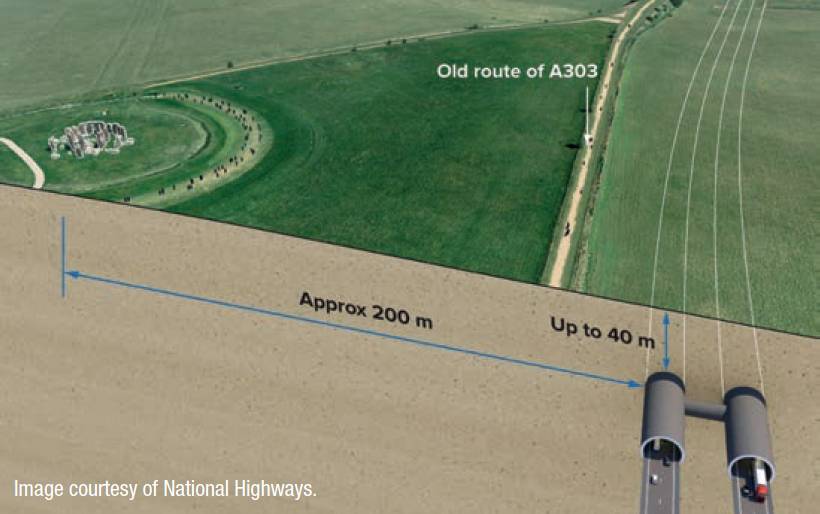
The UK government has approved plans to construct a £1.7bn new two-mile tunnel from Amesbury to Berwick Down in Wiltshire. The major A303 upgrade would see the tunnel run close to the Stonehenge UNESCO World Heritage Site. Consent was initially granted in 2020, however a legal challenge and a High Court ruling against the decision-making process, saw the application undergo a thorough redetermination process and has now been given final approval by the Department for Transport.
Currently, traffic passes the site in a single carriageway of the A303 with congestion forming as people slow down to catch a glimpse of the landmark. It is hoped the new tunnel containing a dual carriageway will help increase road user capacity, cut travel times and benefit communities in the South West while also conserving and enhancing the World Heritage Site.
New high-speed electric railway in Turkey backed by a multi-million pound UK government loan
The £680m UK Government backing will enable the completion of a 286km electric railway in southern Turkey. It will connect major cities with a high-speed, lower-carbon route. UK Export Finance (UKEF), the UK government’s export credit agency, has underwritten the € 781m loan – equivalent to £680m. It will help see Rönesans Holding finish construction of the Mersin-Adana-Gaziantep High Speed Railway on behalf of the Turkish Ministry of Transport to improve rail connectivity and create a sustainable alternative transportation scheme in the country. The deal is expected to create new, multimillion-pound export contract opportunities for the UK’s infrastructure, engineering and project management sectors.
NeuConnect undersea Germany to UK power link construction underway
Construction has begun on the £2.4bn NeuConnect project, a huge undersea power link that will connect the German and UK energy markets. Led by global investors Meridiam, Allianz Capital Partners, Kansai Electric Power and TEPCO, the project will be one of the world’s largest interconnectors powering up to 1.5 million homes during its lifetime.
Montevideo tramway nearing approval
The Ministry of Transport and Public Works of Uruguay has approved a 30year private initiative proposal with the 3 Eses consortium to carry out a feasibility study for a 35km tramline from central Montevideo to the eastern suburbs and Ciudad de la Costa. If the final project is approved a consortium of Stadler Rail, Saceem and Stiler would deliver the $500m project. The aim is to reduce carbon dioxide emissions by the transport sector, reduce congestion and speed up journey times compared with the current diesel bus system. It would follow Montevideo's first tramway which opened in 1868 closing in 1956, and its heritage tramway running from 1967 to 1974.
New tug quay in Port of Rotterdam
A consortium formed by Dutch engineering companies Van Oord, Hakkers, and De Klerk has been awarded a contract to construct a new tug quay in the Port of Rotterdam’s Yangtze Canal. The work will involve 500m of quay wall with space for 12 tugs to berth. The consortium will also remove the existing bed and bank protection, installing new bed protection and dredging around 800,000sqm of sand and clay to widen the canal. The project is scheduled to be completed in spring 2025.
Devastation in Maui
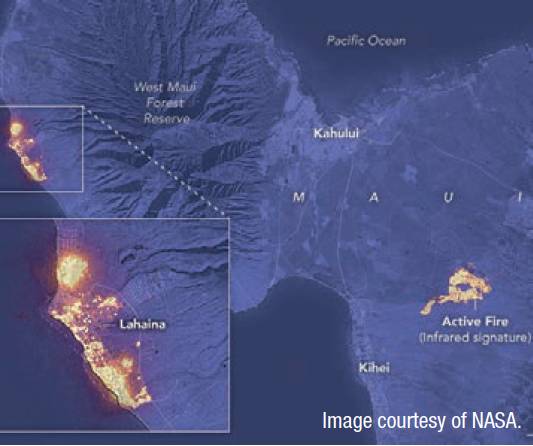
A fast-moving wildfire has devastated an historic town on Maui, Hawaii’s secondlargest island.
This Landsat 8 satellite image shows the fires at 10.25pm local time on 8 August, as observed by the shortwave infrared light (band 6) of the Operational Land Imager.
Much of Lahaina, a town with a resident population of nearly 13,000 people, appeared to be on fire at this time.
The fires occurred during a period of strong winds and dry conditions in Maui, with widespread damage in the county.
In brief:
- Vattenfall has axed a 1.4GW wind farm off the Norfolk coast in the UK, citing losses of € 480m.
- Tata Group has announced it will invest more than £4bn in a new UK Gigafactory.
- The French government's Ministry for Energy Transition will provide the tidal energy pilot farm FloWatt with € 65m of funding. When completed, the HydroQuest-developed, Qair-supported, the tidal energy farm will have the most turbines and largest capacity in the world.
- Fugro has completed the Middle East’s first remotely operated subsea inspection using a low-carbon emission uncrewed surface vessel to survey and inspect an offshore gas platform in UAE waters.
- Balfour Beatty has been selected as one of ten preferred bidders on SSEN Transmission’s £10bn Accelerated Strategic Transmission Investment (ASTI) framework, responsible for delivering the onshore transmission infrastructure within SSEN’s ‘Pathway to 2030’ network redevelopment programme. Contract awards are expected later in 2023.
- Funded by the Department of Levelling Up, Housing and Communities, Nottingham City Council is a step closer to creating a digital twin for the city. In what’s believed to be a UK first they are combining Bluesky’s MetroVista 3D mesh with existing photogrammetric 3D modelling within the same application to enable them to visualise new developments in an immersive real-world environment.
- The first-ever 3D-printed concrete headwall is being trialled as part of the construction process on National Highways’ A30 Chiverton to Carland Cross upgrade in Cornwall. Installed by Costain on one of the dualling project’s underroad wildlife crossings, once completed, the scheme will provide 33 multi-species crossing across the length of the new 8.7-mile dual carriageway.
- Bentley Systems’ iTwin Ventures has acquired Blyncsy, a provider of breakthrough AI services for transportation operations and maintenance.
- The Royal Institution of Chartered Surveyors has appointed Justin Young, as CEO.