
UTILISING AI EFFECTIVELY
The inescapable talking point of the industry in recent months has been AI, be that the seemingly endless possibilities or the potential pitfalls it presents. Civil Engineering Surveyor sat down with Dominique Meyer, founder and CEO of Looq AI, to discuss current trends in AI and how he is utilising qPole technology to make important strides in the realm of field capture.

I did my PhD at the University of California, San Diego, where I was looking at how we build camera systems to replace LiDARs on self-driving vehicles. You’ve probably seen the Waymos and the expensive autonomous vehicles that they were trying to build about five years ago. My hypothesis for the PhD was can we build camera systems to now reduce the price for sensing but improve its capabilities?
The comparison I used to make was that with our cameras you could see within centimetres how far a pedestrian across the road was, 200m away. Compare that to LiDAR, where it is very hard to do that. There are clear advantages of being able to pull together resolution at 3D sensing from that.
Following on from that, I became the CTO of a cool safety product called CamerEye. We were basically building cameras to detect children and people inside swimming pools in backyards. Then I joined another company called Spectral MD, which is a diagnostic imaging company for burn wounds.
I helped write the technology stack to be able to then get FDA clearance and IP on the back of that, Spectral AI. So, it’s been a good journey. And, obviously, from there I started Looq AI. Everything to do with cameras and AI is my jam, basically!
Looq is a technology platform for the industrial world where we’re basically at the hardware stack. The hardware stack allows engineers, surveyors and field technicians to capture areas very efficiently and quickly on the basis of images and GPS.
When you go to the back office, OEI in the cloud will actually take all those images and transform them into 3D models. Traditionally, for the civil and survey side, we’re going to be generating more traditional outputs, home clouds to geo-orthos, which are basically geo-referenced orthographic images. Then get used to going to AutoCAD, Autodesk style tools.
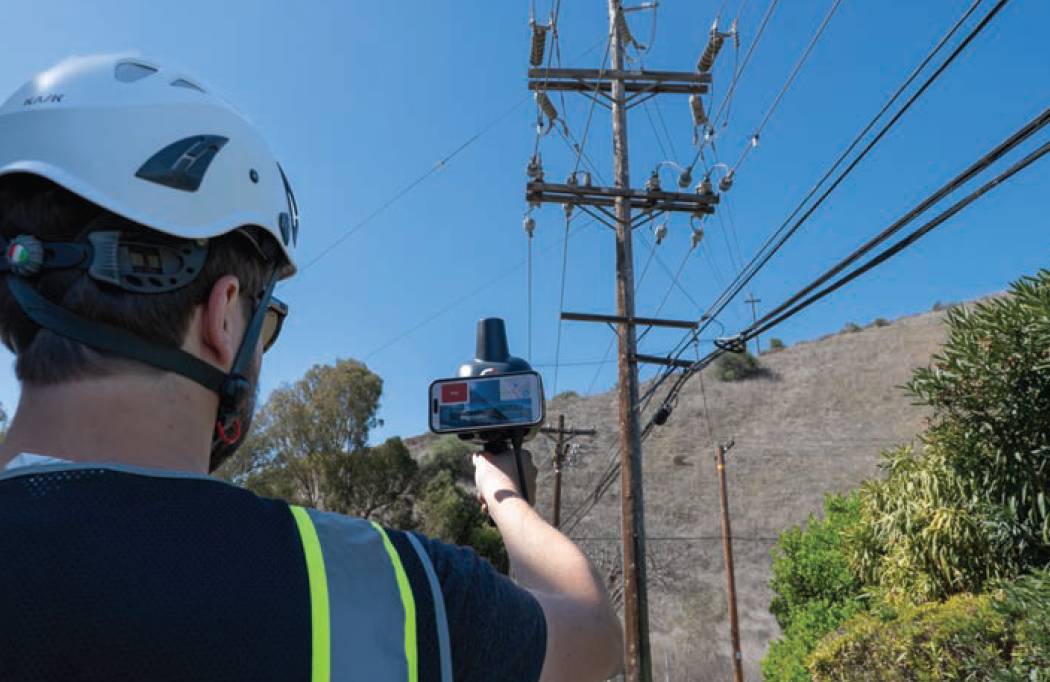
The Looq AI qPole captures immersive imagery of utility poles and overhead lines for digital asset documentation. ©Looq AI
The qPole is basically a way to do automatic component modeling of the images and 3D model to be able to do full structural analysis on that. So, we’ve actually invented the first AI model in the world that detects 2D points across multiple images into 3D to detect very high accuracy structural points to represent the geometries of those members.
qPole is used by utility engineering firms and utilities. If you look at a utility engineering firm, they will get contracted by the utility to do the mapping, as in data collection, of between hundreds to millions of poles per year.
Traditionally, they used to go out with a measuring tape, a hot stick or a laser distance measurement tool to be able to take the attachment heights, the heights at which these wires attach, the height of a transformer.
AI has changed the economy and businesses more than anything... the rate of change is immense.
That was a painful process because every pole took 20-30 minutes to capture. Then they go to the back office to be able to do the representation modelling. They would take each measurement and manually add a component, determining that there’s a cross arm or there’s a transformer on that structure.
With Looq technology, they are now able to directly field every pole within two minutes. Very, very fast fielding. Then, in the back office, the AI will automatically create the model so that the human just goes into quality control, doing everything that the AI doesn’t.
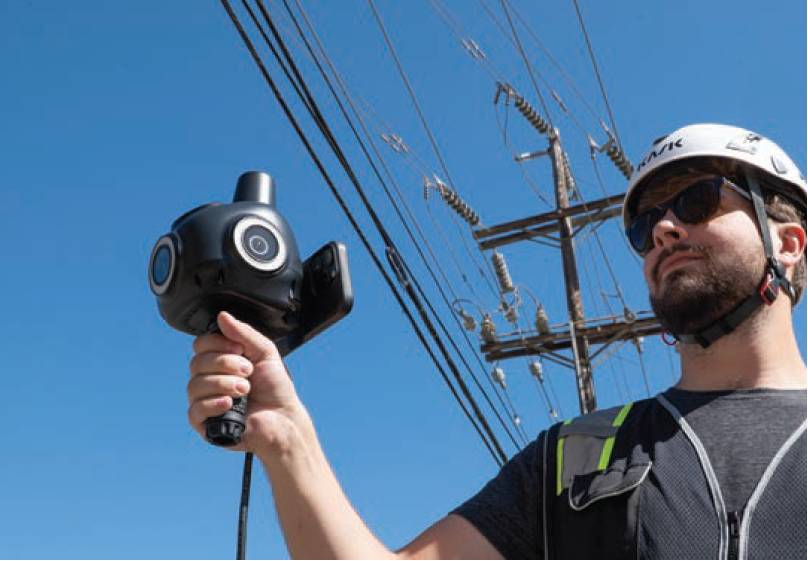
A field technician uses the Looq AI qPole to capture visual data of overhead utility infrastructure from the ground. ©Looq AI
AI has changed the economy and businesses more than anything ever has previously. The rate of change is immense. The beautiful thing is that there are a lot of different applications for AI that have proven to be very, very effective. We all know about large language models and their use in day-to-day lives. Is it contract reviews? Is it looking at automatic document creation?
As soon as you shift to the physical world, those are hard problems to automate with AI because what you’re depending on is the data to be able to do AI-based work. Secondly, it is the wealth of information that is only trainable in the real world, such as being able to look at a transformer and detect rust or the lean of a pole to a degree that is necessary to make an informed decision.
As we look at the industry, AI is directly impacting the cost of goods; being able to reduce time and money to make a unit of good, therefore increasing the margins of the businesses, is why all the businesses and investors are excited. It’s because it makes companies a lot more efficient.
When we look at a human evaluating a structural piece, it is evaluating whether a building is structurally sound. They will go and take measurements, they will look at its condition, they might take some samples of the concrete. That is a very contextual decision making process. You’re considering geometry, you’re considering structural health, you’re considering material properties and you, as a human, are taking that in for a judgement.
Translating that to something like qPole, we are now teaching computers to learn how to combine elements of geometry, structural health, mechanical properties, material properties, to be able to help users be a lot faster making informed decisions. Can the computer now create an automatic rating saying, for example, this pole is a Class A, B or C pole. If it’s C, we need to replace it immediately because it’s a hazard. If it’s B, it’s going to fall over. It might be OK, but we should be adding these structural components to make it more robust. A, it’s a fine pole to work with. Teaching a computer the concepts of geometry, positioning in space and understanding from there, what to do about it is really what we mean with geophysical reasoning.
The US has over 200 million distribution poles across its different states. Those are low-voltage networks to distribute electricity from substations to homes, basically. Those distribution networks are generally quite old. We’re talking an average asset lifetime of over 60 years old for most of those. And those are the most prone to failure because of environmental conditions, especially if you look at the east coast – winter storms have a huge impact.
Hurricanes, strong wind conditions and snow loads on the lines cause poles to be overloaded and then structurally fail. Since there is less regulatory and financial commitments around distribution circuits and for example transmission circuits, that’s been an asset class that’s been very, very difficult to address.
Utilities have been struggling to find a solution to be able to efficiently, in terms of capital and time, manage these large distribution networks.
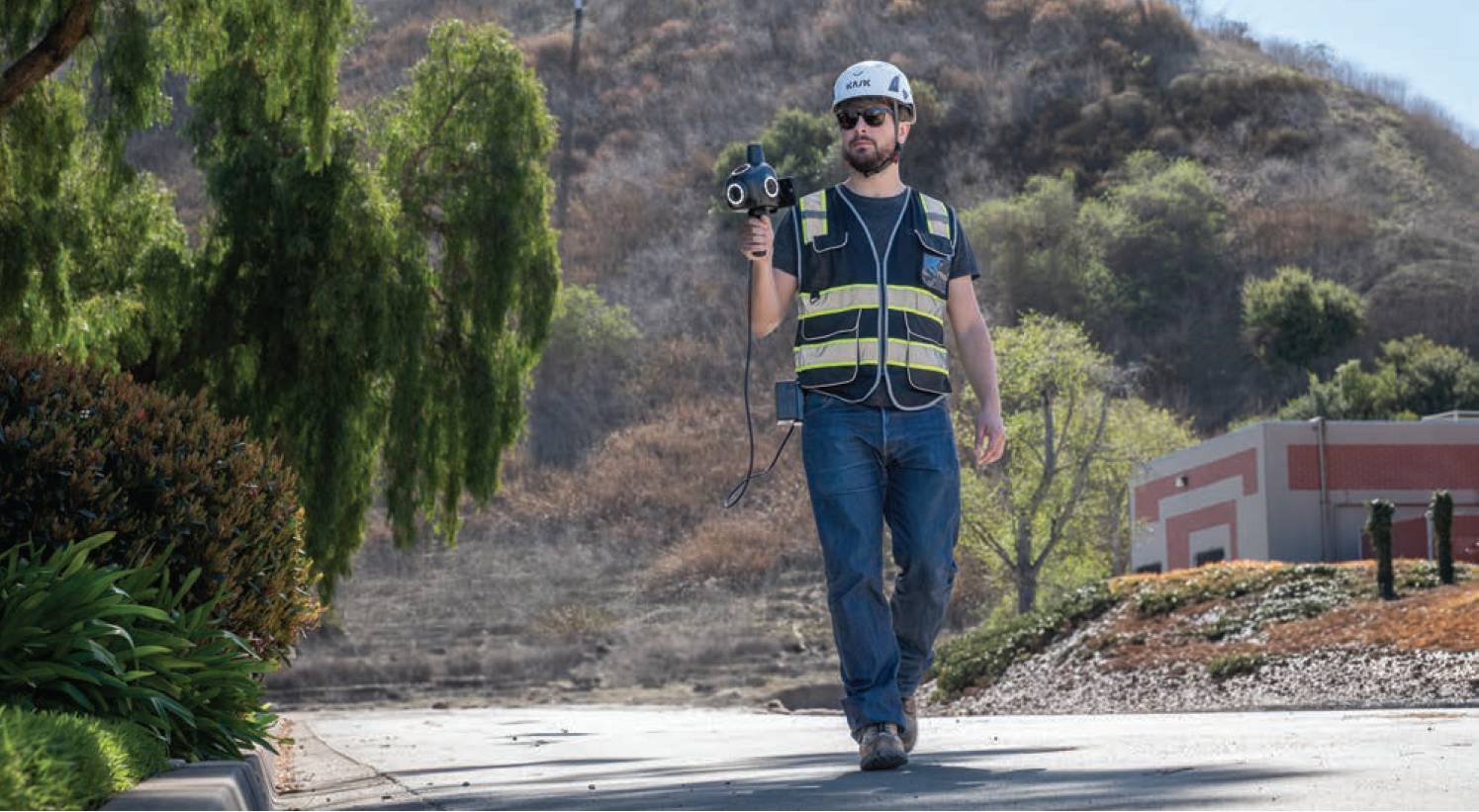
A field technician carries the LooqAI qPole while surveying utility infrastructure along a roadside corridor. ©LooqAI
With qPole, what we’ve been able to do is expose utilities to technology that allows them to directly and quickly understand many more assets and what to do about them. What that means is that we can help them prioritise where they spend their time, money and effort. For example, if there’s a pole that is at risk, they can allocate the right kind of resource towards that pole rather than the 10 other poles that are not a problem, which was previously a painstaking task to do because you did not know which of the poles was going to be the problem child. It’s a really efficient way to prioritise resources, basically.
Oh, absolutely. Everything is old and breaking and we don’t have the time and money to fix it. Ageing infrastructure is the quintessential struggle. Again, it is often the case that there are just not enough resources. A lot of new neighborhoods, for example, can be built with underground electric feeds. If you’ve got such a large country, so many homes in states that are dispersed around, you physically cannot go in fast enough to underground enough cables across all homes.
So you’re burdened with the decision of either keeping what’s up there, trying to fix it or improve it or just replacing it and reducing that cost per mile of management. Our approach is, we target the utilities that have the biggest pain points.
What are the hot spots in the area? California and the west coast are wildfire prone, so they’ve been investing a lot of dollars into remediating that.
Texas and the midwest is really about storm resiliency and a lot of programmes have been established around that. South east is really about hurricane hardening, so you’re looking at Georgia, Florida, Alabama, with those we really focus on hurricanes, and then the northeast has really been around vegetation management. Also, winter storm resiliency. We’re seeing these hot spots of pain points and, by helping address them, we are really highlighting how necessary this technology is.
Utilities have to very carefully prioritise resources to do the most effective work
We’re seeing a shift in the industry where everyone wants to work in the office and utilities have a real struggle on their hands, as it’s a physically intensive job. You need to go out at 3am, climb up poles, fix them, figure out what’s happening. All of a sudden, every person you have in the field is an expensive resource, and a limited one. So, utilities have to very carefully prioritise those resources to do the most effective work.
If they could spend one day with one crew to fix 10 small problems that are going to prevent a big problem, that’s going to be cheaper, easier and faster to fix than if you have to fix the consequences of not addressing that. Fixing a line before it goes down is a lot cheaper than fixing a line once it is down because of something happening to it. That’s a real problem utilities are navigating. How do we optimise in a resource-constrained environment?
I’ll give you an example. When you’re looking at a wood power pole that’s 60 years old, that wood power pole may be fine structurally, but it just needs a metal brace to be strapped to it to be able to improve its structural strength. That metal brace addition, that might be a cost of $5,000 or less. A wood pole replacement, however, might be in the region of $150,000.
So, if a utility can choose $5,000 with three hours of work versus two days of full replacements, what are they going to choose? The right decision is also, hopefully, the cheaper one. qPole can help save an estimated 19 million work hours annually in the US. It enables utilities to address maintenance backlogs without hiring additional staff and it allows personnel to redirect their time toward grid hardening, failure prevention and modernisation projects rather than data collection.
We’re increasingly getting into predictive maintenance, basically saying we’re not going to try to associate a risk profile with time across components within your circuit. Is it a pole? Is it a cross arm? Is it a transformer? Predicting when that piece of asset is going to be a problem. That’s going to be very valuable because we can now work our way into planning a lot more. Today, Looq takes the state of condition today as it stands, and it’s very helpful. But now let’s try to project how things are going to look in six months, 12 months, 24 months. That’s going to allow us to have a very good insight.
Looq is a horizontal platform. We’ve built an omnipresent survey technology that is world-class, with the imaging, the reconstruction, the AI feature extraction to be able to do that and we are going after vertical industries. Today we’re tackling distribution and utility engineering. Engineering as one vertical industry, we’re also attacking civil surveys, more traditional survey work. There will be other verticals that we will be attacking as well. There are a lot of opportunities in this market and our AI will directly apply to those different verticals.