/CES - (90b378c6-7cd0-41e8-ad20-f8936d61b90e)/article/Screenshot 2026-05-15 at 10.04.12.png)
TRUST, TRANSPARENCY AND CARBON
Trust is perhaps the most important instinct in any type of relationship; once it breaks down, the relationship crumbles piece by piece until there is nothing left. In business, I would categorise the people and companies I trust as true professionals – fully transparent, even when things go wrong. However, I would dare to say that nearly every company I have worked with and trusted, at some point in the past or present, has failed to be fully transparent about how its actions affect the environment. This includes my own company. Why?
Winning work in the public sector, to help deliver the government’s ambitions for the country, requires a war chest of documentation at tender stage. The easiest way to learn how to win a government contract is simply to enter one – and when you lose, insist on feedback. Update your submission, try again, seek more feedback and keep going until your tender documents score evenly on quality, at which point you are essentially competing on price. Cynical, I know, but this has been my experience.
One of the standard documents in that war chest during the last two decades was the ‘environmental statement’ – a declaration of a company’s intentions, values and long term commitment to protecting the environment. Everyone had one; some were probably identical.
The act of producing that statement and submitting it to win work was perfectly acceptable and in some ways a small step towards raising awareness that the environment mattered. The business always intended to act on the commitments it made; however, the follow through was given low priority.
Once the statement secured entry into the tender process, any further action was viewed primarily as an additional cost. As a result, the statement functioned more as compliance paperwork than a driver of genuine operational change.
Everything changed in June 2019 when Net Zero legislation came into force, requiring companies to fundamentally rethink their business models and operations to reduce carbon emissions.
Everything changed in June 2019 when Net Zero legislation came into force, requiring companies to fundamentally rethink their business models and operations to reduce carbon emissions. For some of the more forward-thinking organisations, this was the moment the penny finally dropped – this wasn’t a passing trend. Such a significant piece of legislation must have been driven by compelling scientific reasons.
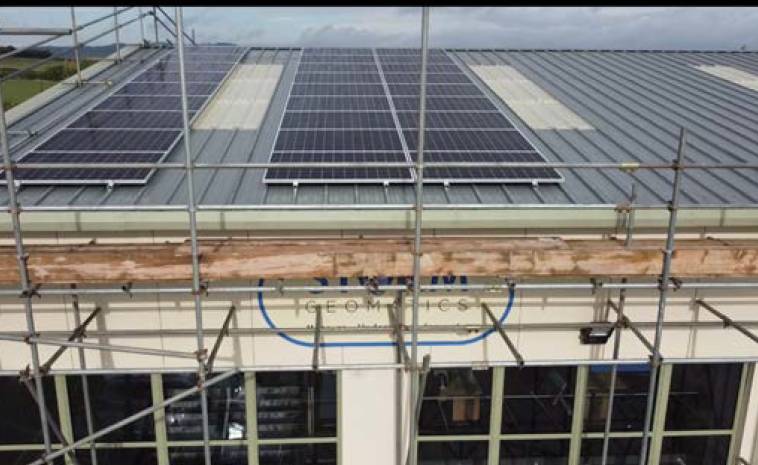
Solar panels being fitted to the Storm Geomatics office.
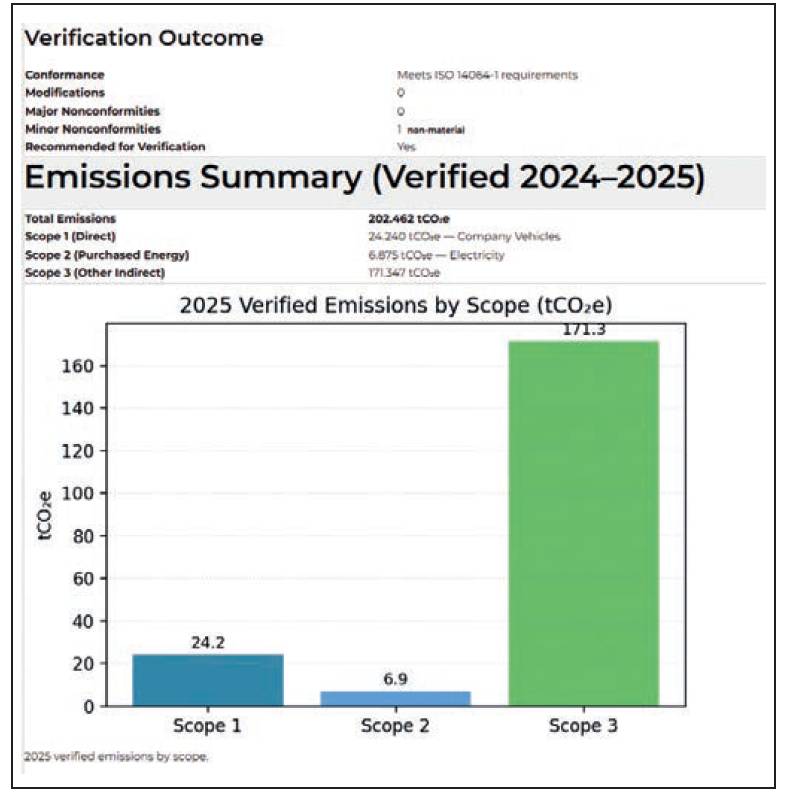
For me, that was the turning point. I began reading scientific research on climate change and its impacts on our planet. What I found consumed me; it fascinated me, shocked me and at times, frightened me. But above all, it ignited a determination to act and to contribute to meaningful change. Reducing an organisation’s carbon footprint ranges from simple to complex, but what makes the effort truly effective is having your carbon accounting independently verified.
Third-party verification not only guides you through the process and reveals where the most meaningful gains can be made, but it also makes your efforts credible and your statements trustworthy. It gives you the confidence to publish your carbon report publicly, offering complete transparency to clients and suppliers. But at what cost?
Reducing carbon emissions influences all three pillars of sustainability – social, economic and environmental – so what may initially appear to be a financial cost is often a long-term benefit. For example:
- Social sustainability: A verified carbon reduction report strengthens trust and helps attract talent. It supports higher morale, productivity and staff retention. It reinforces customer and supplier relationships and contributes to a safer, healthier workplace.
- Economic Sustainability: Verified carbon reporting can help win more work. It can be used to streamline operations, increase efficiency and reduce costs – for instance, through lower vehicle emission taxes or reduced energy bills. It also lowers the risk of costly reputational or legal damage.
- Environmental Sustainability: A verified carbon report ultimately contributes to protecting the environment in which our profession operates. Working in a declining environment becomes increasingly difficult, dangerous and expensive.
One example of a benefit of a verified carbon report is that clients can use the suppliers’ figures to credibly reduce their own carbon emission report totals. Most companies on a Net Zero mission will actively seek out suppliers that can do this for them, as these (scope 3) emissions are out of their control, and are nearly always the highest category of emissions for a company, for these reasons they are the most difficult to reduce. Recently we reduced a client’s carbon emissions report by 52 tCO2e per year by linking them with our publicly available report on our website.
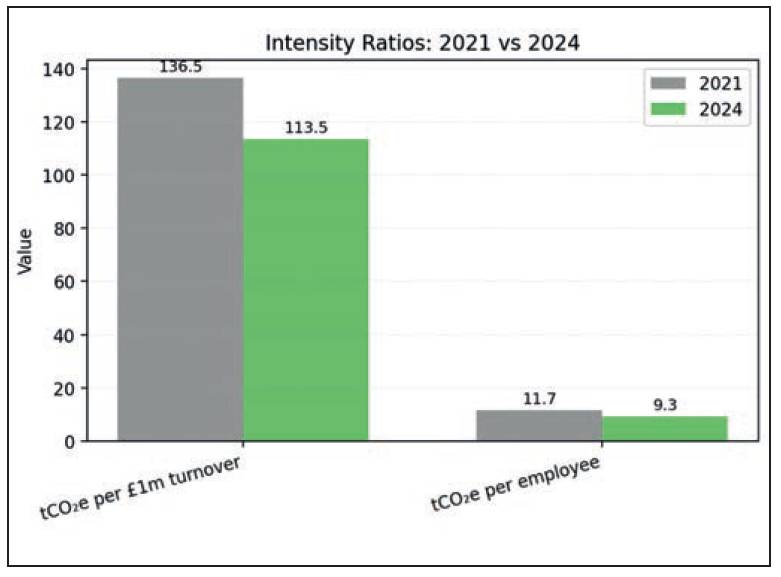
They used our actual value of kgCO2e per pound against their expenditure on our surveying services, which was lower than the DEFRA default value for our profession, thus they were able to provide a more accurate and lower total carbon report.
There are many other benefits to verified carbon reduction beyond this example and those listed here, most of which surface only once actions are implemented. But it is clear that verification transforms sustainability from a cost perception into a profit driver across all three pillars.
In the end, trust and transparency are essential ingredients of a credible sustainability mission. For years, environmental statements served as little more than tender documents, rarely driving meaningful change. Today, that approach is no longer enough. The urgency of the climate crisis, the reality of Net Zero legislation and the expectations of clients, employees and society demand something deeper and more impactful.
A verified carbon reduction report turns intentions into action, replaces assumptions with evidence and creates genuine value across all three pillars of sustainability. Verification not only proves the credibility of a company’s carbon report; it restores trust, strengthens relationships, sharpens competitiveness and safeguards the environment we depend on.
If geospatial accuracy and data integrity define our profession, then isn’t it time we held our carbon reporting to the same standard – where it matters most?