
AN UNCERTAIN FUTURE
AI: The future for construction or simply hype and a distraction?
It is hard to escape the near-constant discussion of artificial intelligence (AI) in the construction industry. For many, the endless hype has led to a sense of fatigue, with a growing scepticism about whether AI is a genuine catalyst for change or merely a distraction from the core challenges of project delivery. This article aims to cut through the noise, offering a pragmatic perspective on AI’s real-world impact. We will explore a practical framework for understanding your organisation’s AI journey, address the common fears and misconceptions that hinder progress and outline a strategic pathway for harnessing AI’s transformative potential.
The truth is that AI is neither a silver bullet nor a passing fad. It represents a fundamental shift in how we can approach project delivery, but its successful adoption hinges on a clear-eyed understanding of both its capabilities and its limitations. The choice before us is not whether to engage with AI, but how to do so in a way that is strategic, sustainable and, ultimately, value-driven.
For decades, the construction industry has been grappling with a persistent productivity problem. The iron law of projects, a term coined by Professor Bent Flyvbjerg, grimly summarises the industry’s performance: over budget, over time and under-delivering on benefits, time and time again1. The data paints a stark picture: while 100% of projects start with the best intentions, only 47.5% finish on or under budget. A mere 7.8% manage to meet both budget and time targets. Most alarmingly, a vanishingly small 0.5% of projects succeed in delivering on budget, on time and achieving their intended benefits.
This is not a new problem. In the UK, the construction sector’s productivity has been a longstanding concern. Data from the office for National Statistics (ONS) reveals that the industry has struggled to recover from the 2008 financial crisis. In September 2008, the construction workforce stood at 2,371,000. Over a decade later, in March 2019, that number had barely changed, sitting at 2,365,0002. This stagnation in the workforce, coupled with a flatlining output per hour worked, underscores a deep-seated productivity challenge that cannot be ignored. It is within this context that AI emerges not as a speculative technology, but as a potential solution to these systemic issues. Globally, AI is projected to contribute an astounding $15.7trn to the global economy by 2030, a testament to its transformative power3.
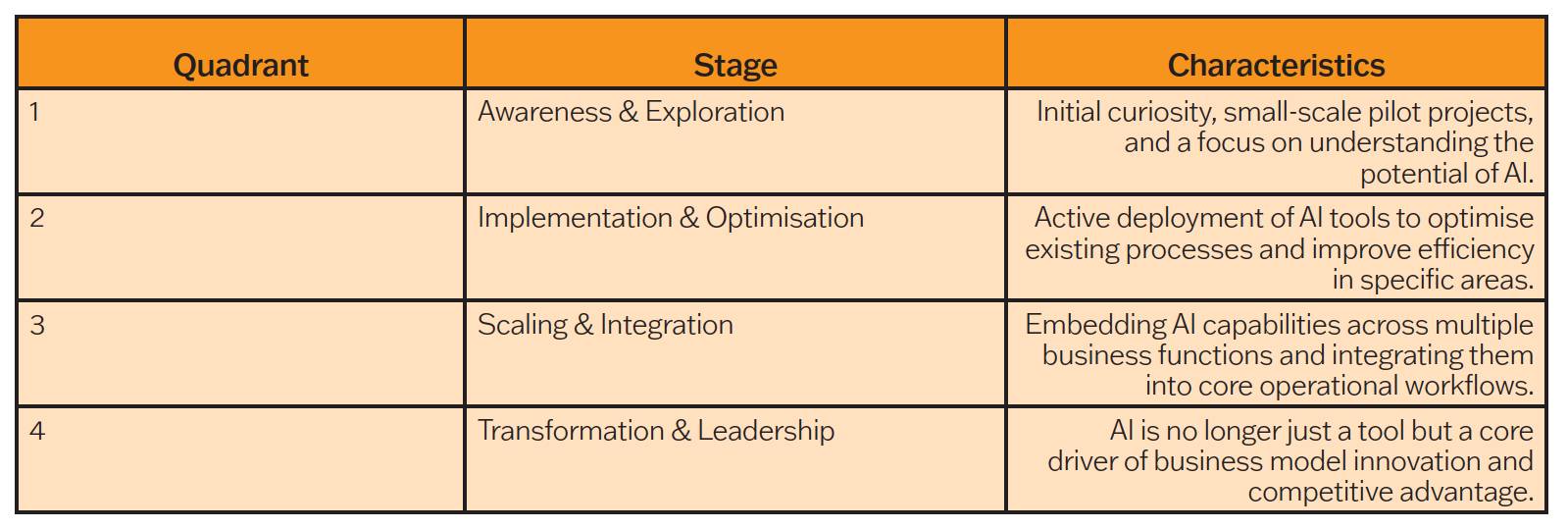
To move beyond the hype, organisations must first understand their current position on the AI adoption curve. We have developed a quadrant framework to help leaders identify their stage of maturity and chart a course for advancement. This model is not a rigid set of boxes, but a guide to understanding the natural progression of AI integration, from initial curiosity to full-scale business transformation.
The key is to understand that AI is not a plug-and-play solution, but a capability that must be nurtured and developed over time.This journey is powered by two distinct but complementary types of AI. Analytical AI is the logical engine, analysing vast datasets to identify patterns, predict outcomes and optimise decisions. In construction, this translates to more accurate project scheduling, optimised resource allocation and proactive safety management.
In contrast, creative AI is the imaginative force, generating novel content and inspiring new ideas. This can be seen in generative design, where algorithms create countless design options based on a set of constraints, or in the creation of synthetic data to train other AI models.
Progress through these quadrants is rarely linear. Many organisations experience an AI empowerment curve, a journey marked by an initial lightbulb moment of recognising AI’s potential, followed by a sobering reality check as the true complexities of implementation become apparent. Overcoming this phase is crucial for building momentum and accelerating progress. The key is to understand that AI is not a plug-and-play solution, but a capability that must be nurtured and developed over time.
The adoption of any transformative technology is inevitably accompanied by fear and uncertainty. AI is no exception. To move forward, we must address these concerns head-on, separating the myths from the reality. One of the most pervasive fears is that AI will lead to widespread job losses. History, however, offers a different perspective. A 1979 IBM presentation slide, which stated: “A computer can never be held accountable; therefore a computer must never make a management decision,” highlights that anxieties about technology’s role in the workplace are not new.
The reality is that AI is not about replacing humans but augmenting their capabilities. We are already seeing the emergence of new roles that were unimaginable a decade ago: Chief AI officer, construction AI data analyst and digital twin manager, to name a few. The construction sector faces a critical skills shortage, with an estimated 439,000 new workers needed just to build the data centres that will power our digital future. The challenge is not one of replacement, but of upskilling and adaptation. Another common misconception is that AI is a “black box” that cannot be trusted with critical decisions. This fear often stems from a misunderstanding of AI’s role. AI systems are tools, and like any tool, they are only as effective as the people who wield them.
The real value of AI lies in its ability to enable predictive and prescriptive analytics, allowing us to not only forecast what will happen but also to determine the best course of action.
The future of engineering leadership lies not in blindly following algorithmic recommendations, but in becoming “agent operators” who can orchestrate a symphony of intelligent systems. This requires a new set of skills: Context engineering, the ability to design precise instructions for AI agents; agent orchestration, the coordination of multiple AI systems; and human-AI leadership, the art of conducting this complex interplay of human and machine intelligence.
Finally, there is the perception that AI is too complex and expensive for all but the largest enterprises. While it is true that developing cutting-edge AI models can be a resource-intensive endeavour, the landscape of AI is rapidly democratising. The key is to adopt a “strategy first, technology second” approach. Before investing in any AI solution, organisations must first ask themselves: What problem are we trying to solve? What data do we have? And how will this create a competitive advantage? By focusing on high-impact, lower-risk applications first, organisations of all sizes can begin to unlock the value of AI.
So, how can construction firms move from being passive observers of the AI revolution to active participants? The journey begins with a clear-eyed assessment of your organisation’s position on the analytics maturity curve. Most firms are currently in the descriptive or diagnostic phase, using data to understand what has already happened. The real value of AI lies in its ability to enable predictive and prescriptive analytics, allowing us to not only forecast what will happen but also to determine the best course of action.
The analytics maturity journey unfolds across four distinct stages. Descriptive analytics answers the question: What happened? This is the foundation, where historical data is analysed to understand past performance. Diagnostic analytics goes deeper, asking: Why did it happen? This requires root cause analysis and pattern recognition. Predictive analytics shifts the focus forward, asking: What will happen? By identifying trends and patterns, we can forecast future outcomes with increasing accuracy. Finally, prescriptive analytics is the pinnacle of maturity, answering: How can we make it happen? This is where AI truly shines, recommending specific actions and optimisations to achieve desired outcomes.
For construction firms, the implications are profound. If your organisation is still operating primarily at the descriptive level, simply reporting on what has already occurred, you are missing the opportunity to shape future outcomes. The firms that will outperform their competitors are those that invest in the infrastructure and expertise to move up this maturity curve.
The concept of vibe coding, named Collins Dictionary’s Word of the Year for 2025, offers a compelling glimpse into this future. Popularised by Andrej Karpathy, former director of AI at Tesla and founding engineer at OpenAI, vibe coding describes a new paradigm of software development where natural language is used to generate code, allowing professionals to focus on their creative intent rather than the technical intricacies of implementation. As Karpathy himself noted, it enables “creative output while you could forget that the code even exists.” This is the essence of the human-AI partnership: leveraging technology to amplify our own expertise and creativity, freeing us to focus on what truly matters.
One of the most critical lessons we can learn from early AI adopters is the importance of strategic clarity before technological implementation. Too many organisations rush to deploy AI solutions without first asking fundamental questions about their business objectives, data readiness, and competitive positioning.
The principle is simple: Strategy first, technology second. Before selecting any AI tool or platform, organisations must establish a clear understanding of the problem they are trying to solve.
What operational in efficiency are you targeting? What business outcome do you hope to achieve? What data do you have access to, and is it of sufficient quality? How will this capability differentiate you from your competitors?
Only when these strategic questions have been answered can technology selection become meaningful. This approach also mitigates one of the most common pitfalls in AI adoption: the “garbage in, garbage out” problem. AI systems are only as good as the data they are trained on. If your data is incomplete, inaccurate or biased, no amount of sophisticated algorithms will produce reliable results. Investing in data quality, governance and management is therefore not a technical afterthought, but a strategic imperative.
The future engineering leader: From managing people to orchestrating intelligence
The role of engineering leaders is undergoing a fundamental transformation.
Historically, leadership in construction has been about managing people, coordinating teams, allocating resources, and making decisions based on experience and judgement. The future demands a new archetype: the agent operator. This is not a replacement for traditional leadership, but an evolution of it.
The principle is simple: strategy first, technology second. Before selecting any AI tool or platform, organisations must establish a clear understanding of the problem they are trying to solve.
Agent operators possess three critical capabilities. First, context engineering; the ability to design precise, unambiguous instructions for AI systems. This is not about coding or technical expertise, but about translating business objectives into clear parameters that AI agents can understand and act upon. Second, agent orchestration: the skill of coordinating multiple AI systems working in concert, ensuring they are aligned, non-redundant and collectively advancing organisational objectives. Third, human-AI leadership; the art of conducting this symphony of human expertise and AI, making the final decisions and taking responsibility for outcomes.
This evolution in leadership reflects a deeper truth: the future of construction will not be determined by those who can best manage people or technology in isolation, but by those who can orchestrate the two in harmony. The construction firms that will lead their industries are those whose leaders understand that AI is not a threat to human judgement, but a powerful amplifier of it.
AI is not a panacea for the construction industry’s longstanding challenges. It is, however, the most powerful tool we have for driving meaningful and lasting change. The question is no longer whether AI will transform the industry, but how quickly and effectively we can harness its potential. The firms that will thrive in the coming decade are those that move beyond the hype, confront their fears, and embark on a strategic journey of AI adoption.
The construction industry stands at a crossroads... the future of construction will be built by those who can master the art of orchestrating the symphony of human expertise and AI.
The path forward is clear. First, assess where your organisation stands on the AI maturity quadrants and the analytics journey. Second, identify high-impact use cases that align with your strategic objectives. Third, invest in the data infrastructure and governance required to support AI systems. Fourth, build internal capability through upskilling and training programmes. Fifth, foster a culture that embraces human-AI collaboration rather than fearing it. Finally, measure progress rigorously and iterate continuously.
The construction industry stands at a crossroads. The data tells us that the status quo is unsustainable: with only 0.5% of projects delivering on budget, on time, and achieving their intended benefits, the imperative for change is undeniable. AI offers a pathway to transform this reality, but only if we approach it with clear eyes, strategic thinking and a commitment to continuous learning. The future of construction will be built by those who can master the art of orchestrating the symphony of human expertise and AI. The question is not whether you will join this transformation, but when.
1 Flyvbjerg, B. (2021). The Iron Law of Megaproject Management. Oxford University Press.
2 Office for National Statistics. (2021).Productivity in the construction industry, UK: 2021.
3 PwC. (2017). Sizing the prize: What’s the real value of AI for your business and how can you capitalise?