THE GOLDEN GATE BRIDGE: SEISMIC RETROFIT
Past president Barry Hiscox continues the Letter from America series
I have already introduced readers to the construction of the Golden Gate Bridge across the entrance to San Francisco Bay. However, I may not have mentioned that when designed and eventually constructed between 5 January 1933 and May 1937 to link the city of San Francisco across the bay entrance to Marin County, no special provision had been made to withstand the likelihood of earthquakes in this notoriously susceptible region.
Readers are therefore reminded of the severe earthquake of 1906 in this region along the San Andreas Fault, the epicenter of which was closely offshore from the Golden Gate Bridge location, yet no specific provision was made in the bridge design for future episodes. Aware of this shortfall, the bridge has recently undergone a seismic refit to protect the bridge and alleviate damage by earthquake, the possibility of which could re-occur to some degree in the 2030s.
It is relevant to point out that the San Francisco Bay Area is transected by a series of sub-parallel faults that together accommodate the relative motion between the Pacific and North American plates. This LFA is therefore focused upon the relatively recent seismic Golden Gate refit project, undertaken to counteract/ protect against any such future event at the iconic location. It is further relevant to note that although the Golden Gate Bridge is not expected to actually collapse as a result of a major earthquake, without these anti-earthquake provisions it would nevertheless experience significant damage, causing the bridge to be closed pending major reparations.
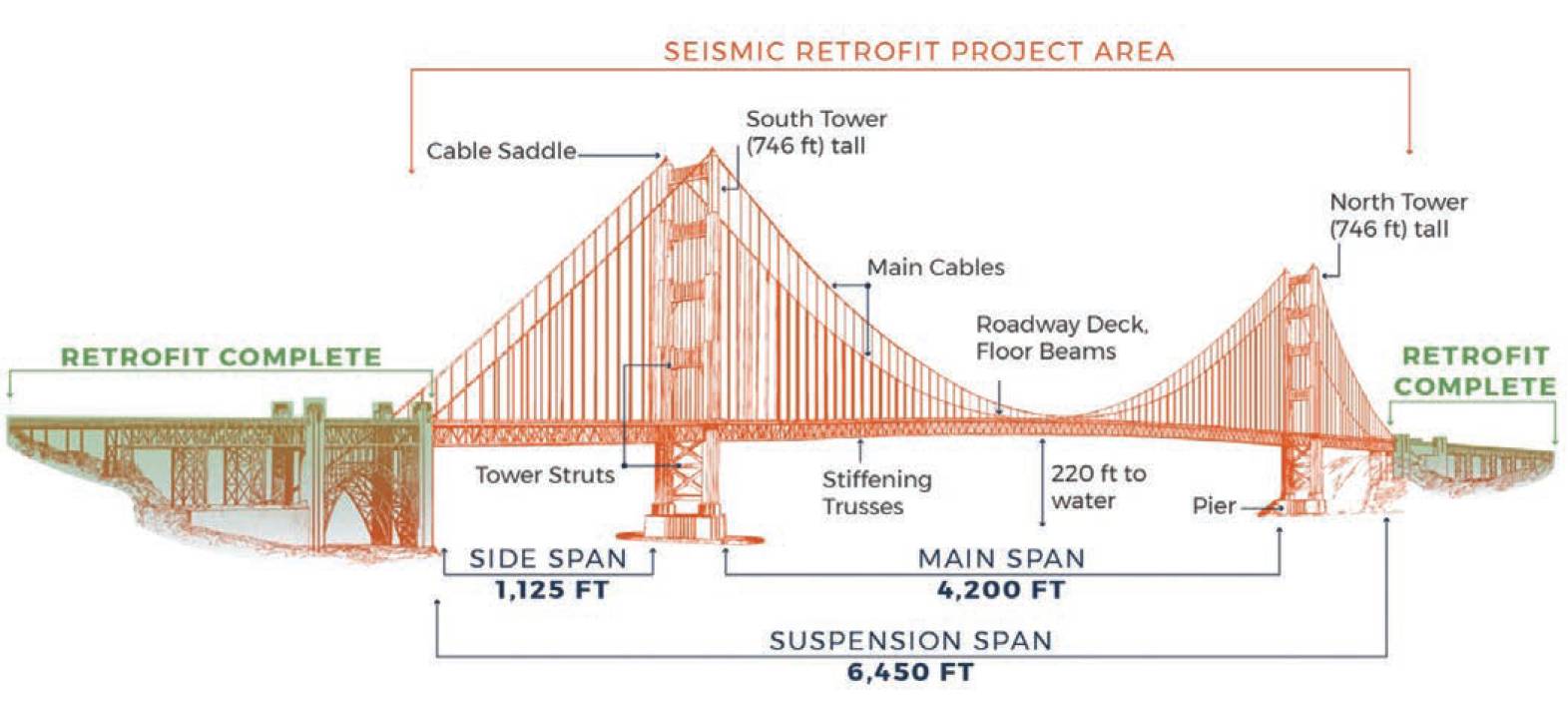
Schematic of retrofit measures for Golden Gate Bridge ©GGBHTD
Beginning in late 2024 and projected to finish in 2029, the bridge is undergoing its final, most comprehensive multi-decade seismic retrofit. This $879m project strengthens the main towers, spans and south pier to withstand major earthquakes, utilising $400m of federal funds to ensure postdisaster functionality. Key details of this final phase 3 retrofit include:
Structural improvements
Installation of massive steel plates at tower bases, upgrading tower trusses and installing 38 energy absorption devices.
Construction approach
Halmar International (CMGC) is acting as construction manager/ general contractor, using night-time closures to maintain traffic.
Complexity
This huge and complex job involves foundation strengthening, installation of micropiles and rock bolts, building reinforced concrete shearwalls and replacing critical structural components, all while keeping traffic moving.
HCSS Software
Halmar used HeavyBid construction estimating software to put together the $879m award-winning proposal for phase 3 of the retrofit.
The originally identified 7.1 magnitude 1980s earthquake, which caused the collapse and rebuild of the critical crossbay link from Oakland to San Francisco, fortunately caused little to no damage to the Golden Gate Bridge. Aware of the risk to the iconic bridge and despite financial constraints, however, the district proceeded with the anti-earthquake strengthening of the approach viaducts, involving improvement of foundations and replacements in a manner protecting against degrees of structural vulnerability, as follows:
Phase 1 (1997-2001)
Marin (north) – Strengthening existing foundations, replacement of four supporting steel towers and strengthening of Bent N11, replacement and addition of top and bottom lateral bracing and strengthening vertical truss members and truss connections, plus modifications to minimise effects of ground motions on the structure. Contract value: $71m.
Phase 2 (2001-2008)
San Francisco south approach viaduct, south anchorage housing, Fort Point Arch – retrofit measures to reflect individual behaviors under seismic ground conditions and their interaction at points of interface while accommodating their already-in-place historic configuration. Contract value: $189m.
Phase 3 (2024 -2029) – main span
The previous events also highlighted the need for improvements to the main span, causing efforts to design and subsequently introduce earthquake-proof measures to the iconic bridge, resulting in extensive seismic retrofit measures to the span, commencing in 2024 and forecast for completion in 2029. Contract value: $879m.
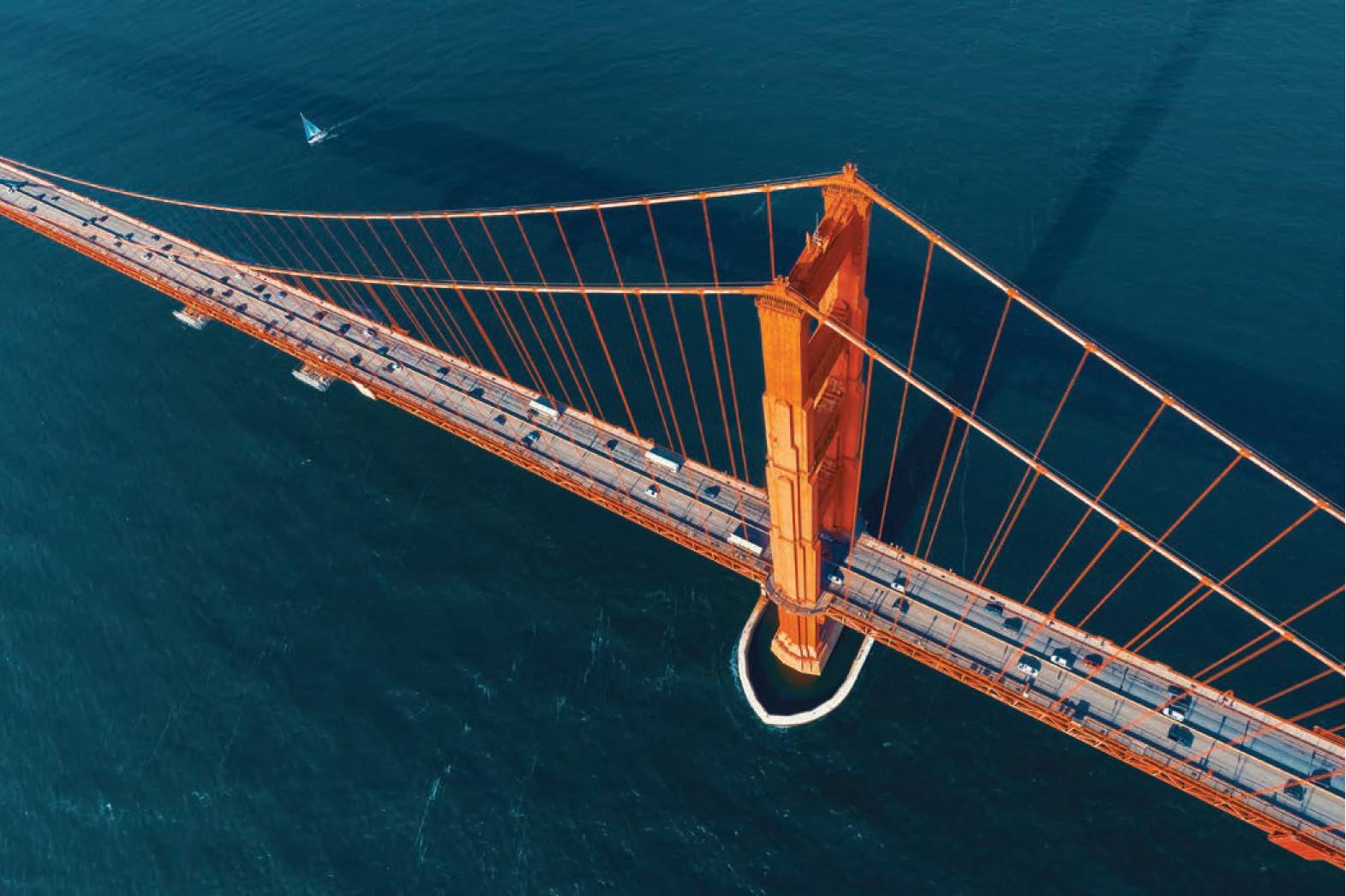
The conclusion by the United States Geological Society (USGS) and other scientific organisations was that there is a 62% probability of at least one magnitude 6.7 or greater quake capable of causing widespread damage impacting the San Francisco Bay Area before 2031. In 1992, following a determination that retrofitting the bridge would be more cost-effective than replacing it, the district hired engineering consultants to develop seismic retrofit design criteria. The site-specific design ground motions associated with different magnitudes of earthquakes and expected performance levels were defined as the basis for the bridge retrofit design. The effort to further protect the Golden Gate Bridge resulted in the above-mentioned phase 3 contract for retrofit of the main span, lasting from 2024 to a forecast completion in 2029.
For its 50th anniversary in 1987, the bridge hosted Bridgewalk ’87, where an unexpected 800,000 people flooded the roadway, causing the iconic structure to sag about seven feet and temporarily flattening its arch under the immense weight, though engineers confirmed it was never in danger. The massive chaotic crowd of 800,000 exceeded the expected 80,000, turning the event into a historic yet cramped and frightening spectacle.
A new barrier system, including the zipper trucks, was completed on 11 January 2015, following a closure of 45.5 hours to private vehicle traffic at a cost of $30.3m to purchase and install. Based on the above sequence of events and resultant safety measures, this famous 1930s landmark is here to stay.
If you are intending to count yourself among the approximately 40 million vehicles crossing the bridge annually, it will cost you the following (payable only in one direction at 1 July 2025 prices):
- FasTrak (Standard): $9.75
- License plate accounts and one-time payments: $10.00
- Toll invoices (missed by mail): $10.75
- Carpool (FasTrak only, 2+ people): $7.75
- 3+ axle vehicles: $29.75 - $48.75+
- No toll booths – all tolls collected electronically or by mail.