QUICK AND EFFICIENT SEWER SURVEYS
Mapping an underground sewer safely and accurately
Ever the innovators, humans were building sewers as far back as 5,000 years ago. Sewers today keep our cities clean and populations healthy. However, around the world, sewer operators and owners are running into similar challenges; the infrastructure is aging, under pressure and existing condition reports are outdated. In some cases, hand-drawn maps are the only record of a sewer’s position. The older maps are often inaccurate and share little to no information about the sewer’s condition. The solution?

The Elios 3 being flown down the manhole by the Academy Geomatics team.
Georeferenced sewer surveys that accurately map the sewer’s position, dimensions and, if possible, its condition as well. Unfortunately, these surveys are challenging, often requiring days of work underground and in confined spaces with high levels of danger. This work is critical, as new construction above ground has to wait for the presence of sewers to be confirmed so the pipes aren’t damaged by the new buildings. Drone sewer surveys, such as with the Elios 3, are speeding up the sewer survey process while eliminating the risks associated with human entry.
Academy Geomatics is a professional surveying company with 35 years of experience. Operating across the UK, its team uses laser scanners, total stations, drones and other equipment to accurately survey everything from building extensions to sewers. In the spring of 2025, the company was asked by Northumbrian Water to survey a sewer pipe in a stretch of land beneath a footbridge marked for potential reconstruction. The local council aimed to improve the post-industrial landscape in that area and needed accurate infrastructure records before they could begin work.
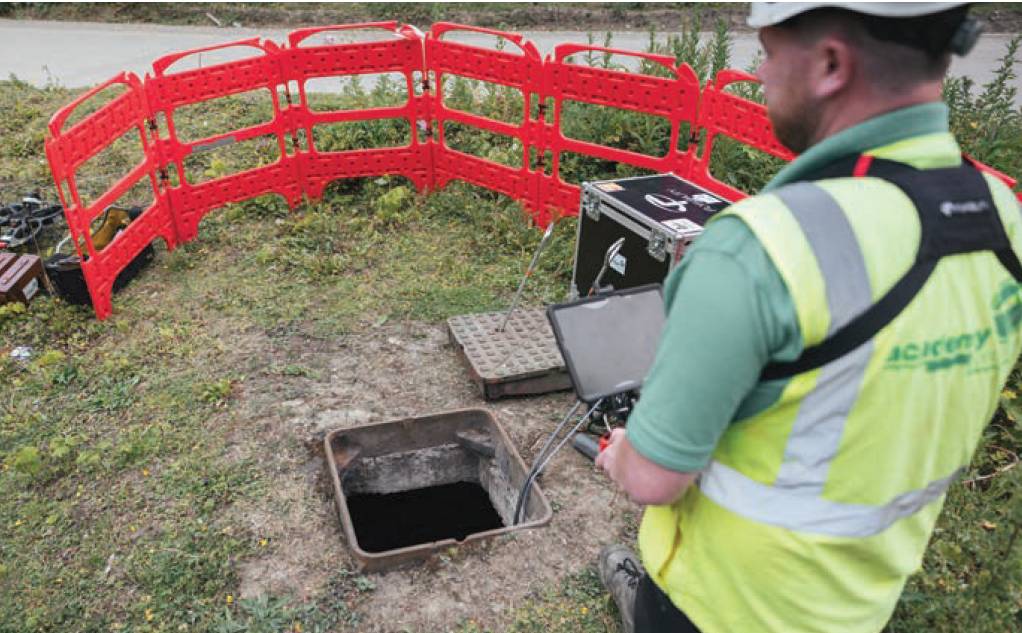
Academy Geomatics was tasked with determining the condition of the sewer as well as its location. It needed to check if it was positioned as expected and see if surface run-off was entering the sewer directly or via a chamber. The surveyors planned to use the Elios 3 drone for this mission, which would enable them to get access to the hazardous space without putting their team at risk in the unknown conditions.
Despite sewer surveys being challenging undertakings, these projects are necessary to keep utility management flowing smoothly. The Elios 3’s features are suited to simplifying sewer surveys, with a combination of hardware and software that includes:
- A rugged design: Thanks to its collision-tolerant cage and custom firmware that recognises and recovers from impact, the drone can be flown with confidence beyond the visual line of sight and inside sewers.
- High-quality data: It is equipped with a centimetre-accurate LiDAR scanner and 4K camera. Together, these tools offer life updates on the conditions around the drone as well as detailed information for inspections and surveys. The quality of the data is accepted by regulatory boards, making it clear that remote access can still provide the critical data needed.
- Custom software integrations: It has a surveying payload that includes FARO Connect, ready for processing and managing the point cloud. In addition, Flyability has an integration with WinCan Web, a sewer management software programme. This means that data collected with the drone can be used in industry-recognised formats.
This sewer had two manholes with a connecting pipe. Each manhole had 10m of depth before the tunnel, which stretched roughly 60m between them. The Academy Geomatics team planned to gather terrestrial scans above ground and use a total station to georeference their results. They would then fly the Elios 3 below ground to gather data inside the tunnel and combine the point clouds in post-processing.

The team used a Trimble S7 total station to georeference checkerboards across the site before using a Leica RTC 360 laser scanner on an invertible scan tripod. They scanned the area above ground and then, using the tripod to lower the scanner down, below the top level of the manhole. This inverted scan would create overlap between the laser scanner point clouds and the Elios 3 ones for easy merging later. Before deploying any equipment inside the sewer, they tested the confined space for explosive gases to ensure there was no risk in this area.
Next came the Elios 3 flights. The Academy Geomatics pilot completed four flights with the drone. The first was a SLAM flight, moving slowly to gather data while also scouting the environment. The second flight was focused on gathering inspection data via video. The final two flights were SLAM-focused flights, optimising LiDAR data collection with the drone’s surveying payload to ensure they had complete coverage of the space.
The structure of this sewer, in particular the 10m descent, could pose a challenge of SLAM scanning, which is why the team followed best practices to ensure it had no slippage in the results. The Elios 3 is also equipped with the flammable gas sensor, alerting it to the presence of over 14 dangerous gases and giving an additional safety measure as it operates beyond the line of visual sight underground. In this project, the sensor detected no hazardous gases and the mission was completed smoothly.
After data had been collected on-site, the team returned to the office and imported the Elios 3 data to Inspector 5 and then FARO Connect. After some filtering and tidying of the point cloud, the point clouds from the Elios 3 and laser scanners were all uploaded to CloudCompare where they were merged to create a final result. This was then imported to AutoDesk Recap for the last stages of analysis before it was shared with the client as a single, final point cloud.
Academy Geomatics’ entire survey, including the work with the Elios 3, was completed by just two people in half a day. This is a huge improvement compared to traditional methods, where it would take a full day to do the initial scans and another two days to traverse the sewer on foot – if it was even safe to do so.
The team on this project, led by Mark Anderson, a co-director of Academy Geomatics, commented on the speed of results possible with the Elios 3. “The drone allows us to get data quickly and safely, massively cutting down on the time we need for rope access as well as costs for having rescue teams on standby. We can survey four large manholes in a day with the Elios 3, compared to just one using traditional surveying tools.”
The results from the surveying payload continually impress both Academy Geomatics and its clients. The Elios 3 point cloud in this project was just 20 millimeters off the terrestrial laser scans, which is a very good result and in the context of this project, meets survey-grade requirements. The client can use a much larger range for planning construction, but these results make it easier to work with precise knowledge of exactly where the sewer pipe is with accuracy to within two centimeters.
The Academy Geomatics team have found that working with the Elios 3 makes the work easier by cutting unnecessary risk exposure and work in confined spaces. There is also a cost savings from the faster work, enabling it to take on more assignments and not needing confined space rescue teams. The quality of work and results has seen it complete multiple assignments for this client and even partner with other surveying companies who ask Academy Geomatics to use its Elios 3 to gather data in challenging environments.
As Academy Geomatics continues to operate across the country, it is expanding the use cases of its Elios 3 drone and experimenting with its newest features, including smart return-to-home and resume inspection. This tool helps to get the data needed without compromising on accuracy. It’s clear that the Elios 3 is taking on a substantial role within surveying operations, opening the door to safer, faster and more efficient missions even in the most difficult environments.