
TECHNOLOGY FUELS INNOVATION
Researchers have developed an AI capable of analysing steel bridge maintenance needs and predicting capacity using data captured by the high-speed, wireless Artec Leo. For this particular project, the challenge was to ease the load on local authorities across the USA, each charged with maintaining thousands of bridges to budget and minimising costly closures caused by safety concerns. This time, using solutions including Artec Leo, Artec Studio, ABAQUS and in-house AI algorithms, bridge beam datasets indicated corrosion levels with such high accuracy that they could be fed into a novel AI that works out capacity and flags the repairs needed to avoid failures.
In everyday life, saying an object is as tough as steel is a way of emphasising its durability. After all, the material is one of the strongest on the planet. But even steel has its limits. Many public bridges, for example, are upheld by steel beams prone to deterioration triggered by extreme weather conditions. With failures having previously caused numerous injuries and fatalities, as well as significant financial loss, around the world, regular inspection is vital to ensuring that these remain safe to operate at full capacity. In cases where bridges are found to be deteriorating, their load limit can be lowered and, in certain circumstances, they may even face closure – at a huge economic cost.
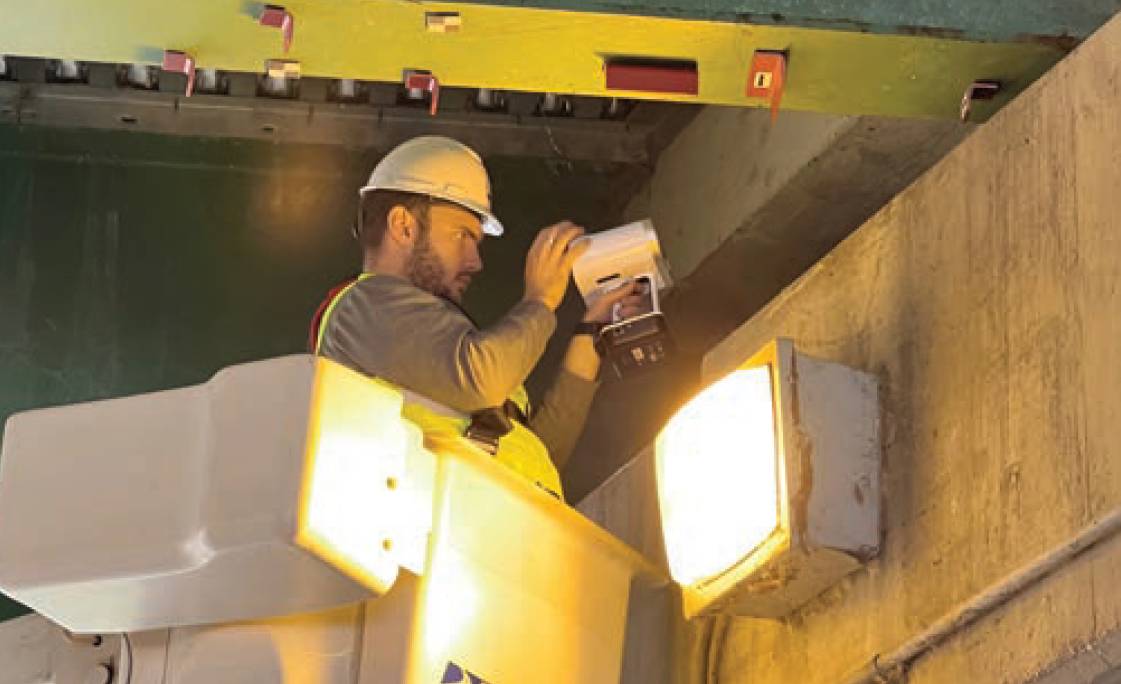
The Artec Leo 3D scanner being used to digitise beams underneath a US bridge.
Authorities manage infrastructure in towns and cities with thousands of bridges, as well as being responsible for providing other public services. This balancing act also makes efficiency essential to stretching resources as far as they will go.
This is why researchers at Technische Universität Dresden and the University of Massachusetts Amherst have begun developing a faster, more accurate steel bridge inspection method. Currently, scrutinising such infrastructure involves removing corroded material and measuring what’s left, using time and labour-intensive
single-point capture. Artec Leo researchers have now identified a far more efficient way of measuring beams and acquiring the highly detailed data needed for faster, deeper analysis.
Initially, the researchers developed their workflow around data captured with a terrestrial laser scanner. The University of Massachusetts Amherst is home to a digital media lab 3D innovation centre filled with advanced technologies, including a tripod-mounted device, which had previously been used to digitise and research open landscapes like river banks.
When it came to identifying corrosion patterns on a decommissioned steel girder, this LiDAR scanner was also found to capture sufficient detail.
On their own, 2D contour maps offer inspectors a quick and easy way of visualising a beam’s condition. But the researchers also wanted to develop a way of using this data to uncover bridge capacity.
However, in real-life bridge inspection, beams need to be measured at either end, in areas requiring a bucket crane to access.
Targeting greater flexibility, the team used Artec Leo, a wireless, all-in-one device with 0.1mm accuracy and a capture speed of up to 35 million pts/s. Supplied by Artec 3D ambassador Source Graphics, Leo is not just fast and compact, it’s incredibly intuitive, making it easy to learn how to use, even for relative newcomers requiring high precision from the outset.
According to Simos Gerasimidis, associate professor at the University of Massachusetts Amherst, because corrosion usually happens to beams – the support structures of the bridge deck – scanning would traditionally have been laborious, with the process involving having to scan one side, stop, move the bucket, then scan the other. So, being handheld, versatile and easy to move around is very important. Leo also informs the user if they are too close or too far away, so you know on the spot if the scan was good or not. With Leo, you’re gathering (at least) hundreds of thousands of points in five minutes. Using traditional methods, you capture one point in three minutes. So, if you measure efficiency by time per data captured, the difference is clear to see.
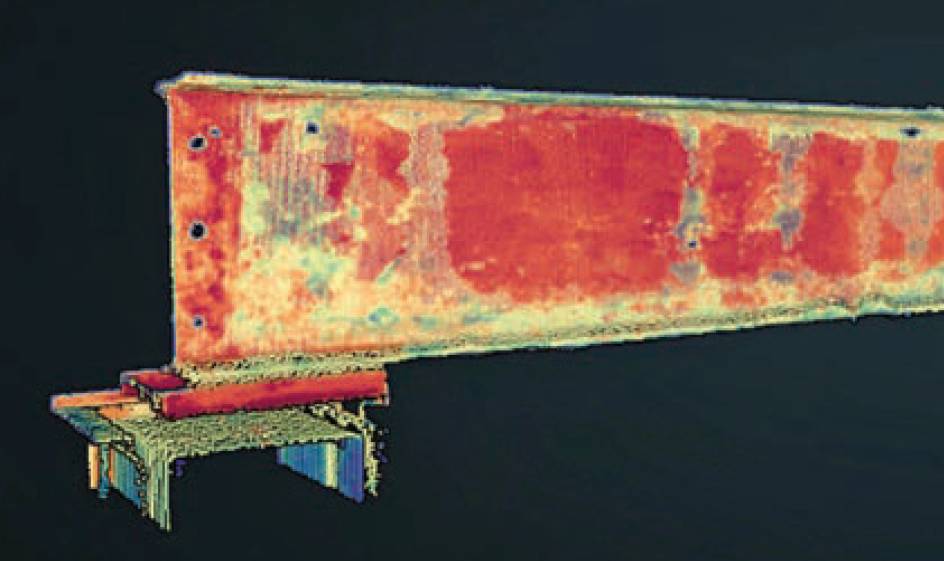
A complete girder 3D scan, including small holes and fine surface details.
Processing began inside Artec Studio, Artec 3D’s scan capture and processing software, featuring HD mode for ultra-sharp scans – even when digitising shiny metal surfaces – and unique algorithms that allow for best-in-class texture and geometry tracking. Beam analysis would also be possible using the programme’s built-in inspection tools, but the team opted to work with raw point clouds instead, to avoid any chance of misalignment.
During data tidy-up, it generated 2D contour maps which illustrated the remaining thickness of each girder’s web plate (or steel panel). On their own, these maps offer inspectors a quick and easy way of visualising a beam’s condition. But the researchers also wanted to develop a way of using this data to uncover bridge capacity.
Once the data had been placed into a coordinate system, the team fed it into the ABAQUS finite element analysis (FEA) software for structural analysis. After repeating this process with multiple scans of three decommissioned beams, it used the combined FEA findings to computationally generate scenarios in which overloading would lead to failure. For each of the 1,400 corrosion scenarios created, an in-house developed algorithmic framework was used to generate a finite element model.
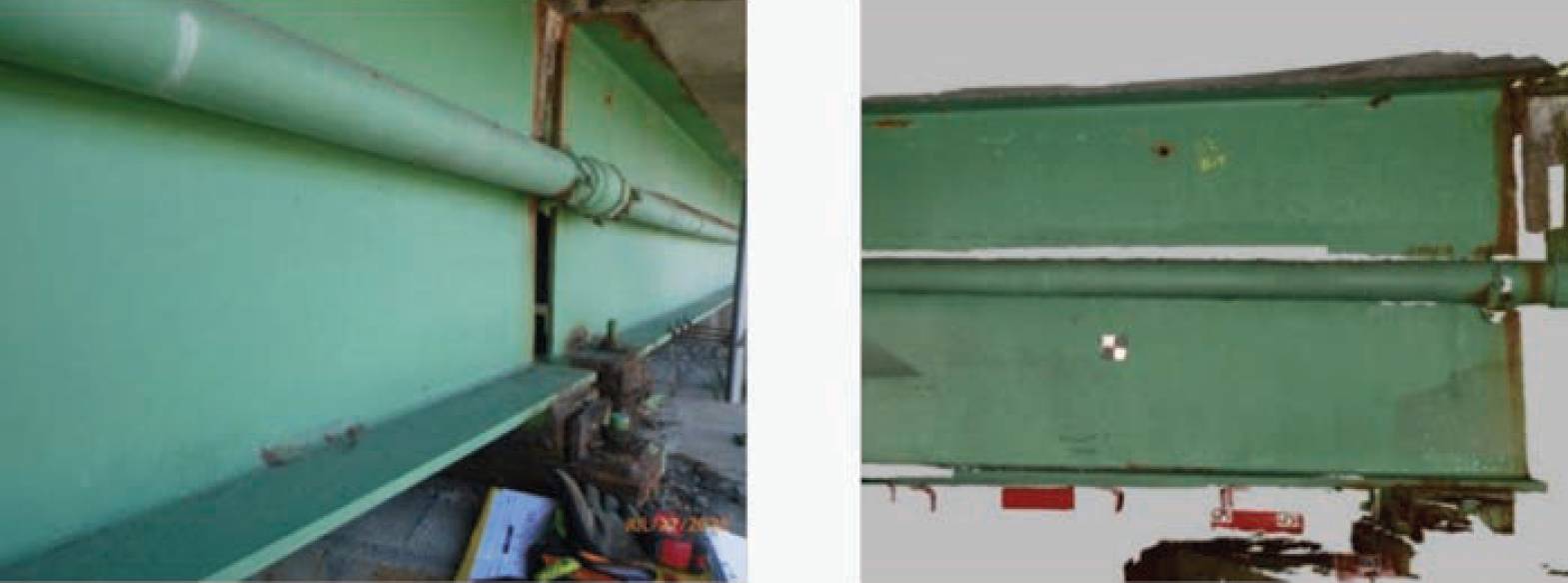
Steel bridge girders showing signs of deterioration (reflected in the captured 3D scan data).
From there, the capacity and exact failure mode of the corroded beam could be identified.
Aiming to further accelerate bridge analysis, the team then used these scenarios to train an AI capable of finding patterns between input data using machine learning and calculating capacity.
The idea was that if load rating engineers fed contour maps captured with 3D scanning into this AI tool, it could automatically assess a beam’s ability to carry predetermined loads. After demonstrating this approach in a controlled environment, the team went on to apply it in practice, with the inspection of an in-service bridge in Massachusetts.
Despite vibrations and accessibility restrictions, it managed to quickly and efficiently identify areas of wear in similar areas across beams and generate the data needed for engineers to assign bridge load ratings with much greater accuracy.
Like conventional bridge inspection methods, the researchers require crane rental and partial road closures, but it’s also faster and significantly reduces inspection uncertainty. With over 20,000 US steel bridges rated as being in poor condition and more than 100,000 rated fair, it’s believed that their more efficient approach could help the Federal Highway Administration and state transport authorities address an estimated $125bn repair backlog.
Moving forwards, the team proposes that its findings be rolled into a comprehensive data collection training course, which brings uniformity to the industry. In the longer term, integrating AI-powered load rating and section loss comparison tools into bridge management systems could also enhance public infrastructure maintenance across the US. There are several US states considering integrating 3D scanning into their workflow – with some already done so. The confidence is there that the technology will continue to grow at a pace that will see significant change in this space over the next five to 10-year span.