
MODERN UPGRADES WITH A LINK TO THE PAST
An in-depth look at the recent bridge installation for Dudley
A new bridge for West Midlands Metro Wednesbury to Brierley Hill Metro extension has recently been installed, representing a significant upgrade on the original. Designed by Tony Gee as a partner of the Midland Metro Alliance, the bridge was installed across Birmingham New Road, Dudley, with the new structure featuring a familiar design iconic to the local area. A specialist signwriter was engaged to create the distinctive brand colours and lettering advertising Hanson’s Mild Ale, similar to the original bridge.
Given the bridge’s status as a local landmark for many years, replicating the historic appearance on the replacement structure was an important aspect. The original was an old through girder construction, three bays, detailed as old British Rail standard bridge design. The replacement was deemed necessary due to reconfiguration to suit alignment and envelopes of both light and heavy rail.
A noteworthy change as part of this reconfiguration is that the structure originally had three tracks, where the new bridge carries two. The track alignment was adjusted to marry up with the new Birmingham New Road tram stop.
The new bridge future-proofs the route for heavy rail and incorporates a set-back eastern abutment to enable safer cycle route connectivity.
The design criteria required the bridge to sustain both heavy and light rail loading to current standards and to accommodate envelopes for both heavy/light rail – this was not possible with the original bridge and the decision was always to replace the bridge deck with a new structure (120 years design life). The subsequent and later decision to widen the footway below meant the existing bridge deck had to be replaced as a function of the widening of the bridge for the provision of the footway/cycleway route from Wolverhampton to Birmingham.
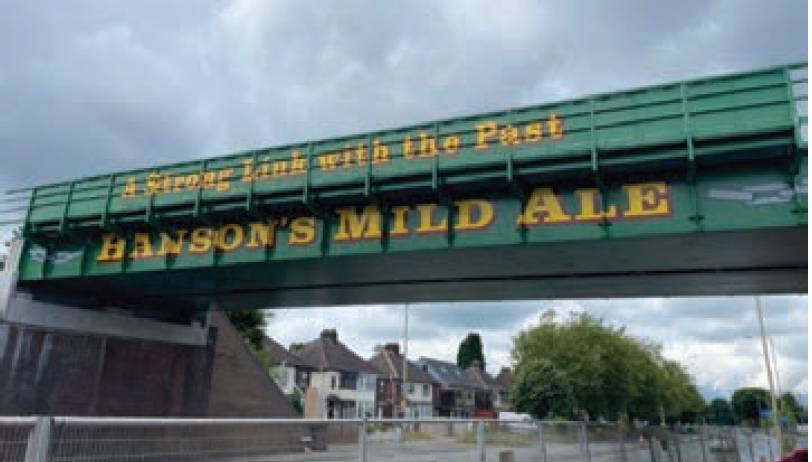
Elevation of the new deck with the parapets attached which boasts the iconic Hanson’s text.
The new bridge future-proofs the route for heavy rail and incorporates a set-back eastern abutment to enable safer cycle route connectivity, helping maximise potential for active travel in the locality. This bridge demonstrates how we can cater for future requirements and preserve local heritage in a sympathetic manner to be greatly valued by local communities.
The Wednesbury to Brierley Hill extension of West Midlands Metro utilises the redundant Dudley-Pleck Junction heavy rail corridor and ties in with the existing Metro Line 1 at Tipton. New bridge decks, designed by Tony Gee in its role as part of the Midland Metro Alliance through the options, approval in principle, detailed design and construction support stages, comprise a replacement structure over the A4123 Birmingham New Road.
The 120-year design life reinforces that the new Hanson’s Mild Ale structure will remain a notable landmark along Birmingham New Road, preserving the site’s heritage for many years to come.
The bridge meets the needs of a modern tramway, enhances active travel opportunities in the locality, maintains conspicuous cultural heritage and the aforementioned future-proofing ensures the line will be well-equipped should heavy rail be later reinstated.
The replacement bridge design is based on two Network Rail standard U-type decks, each with a 23m clear span, modified with an increased width between main girder webs to accommodate track slab and the low tram clearance envelope.
Use of the standard deck detailing streamlined the design, checking and fabrication programme with adoption of proven details for future operation and maintenance. The 23m span is a significant increase compared to the original 18m clear span bridge decks – this change was made after much stakeholder liaison to accommodate a new cycleway in front of a new east abutment.
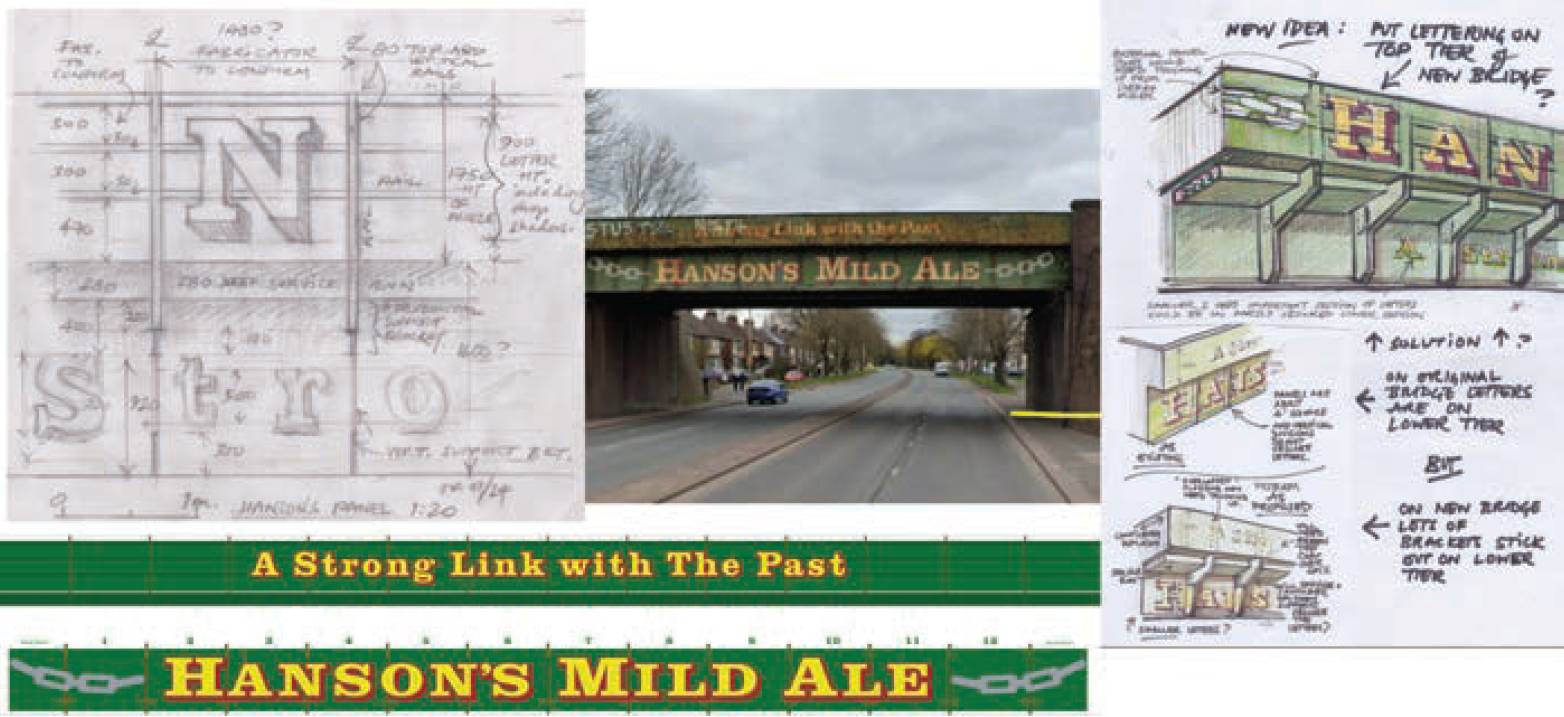
Concept art for the new bridge’s design. Centre: the original bridge.
While the future-proofing of the structure for heavy rail has meant designing for more onerous loading than the lighter tram traffic in the short term, the intended 120-year design life reinforces that the new Hanson’s Mild Ale structure will remain a notable landmark along Birmingham New Road, preserving the site’s heritage for many years to come. Inclusion of the new cycleway promotes the environmental and social elements linked to the drive for a sustainable future by providing safer cycling infrastructure along a busy commuter route, separated from road traffic, with the goal of encouraging increased use of other sustainable forms of transport alongside the metro.
The core function of the Midland Metro Alliance is to plan and deliver multiple tram extensions across the West Midlands. It does, however, deliver other tram related enhancements such as the massive modernisation of the depot in Wednesbury, a number of track replacement projects and power enhancements ensuring that the existing line remains resilient as the network grows.
Combining these improvements with a touch of the classic flair of its predecessor, keeping the old design and colour palette, the new bridge has been well received by locals who appreciate the efforts of the design team to incorporate a strong link with the past; despite the production of Hanson’s Mild Ale being discontinued in 2007, it had been brewed locally since the 1860s.
This decision was made in collaboration with Dudley Council, as the designer always had the aspiration for the artwork to be reinstated. The DMBC artist could not carry out the works, so we used a separate company who painted the artwork at the steel fabricators yard off site.
The desire to not significantly alter the appearance of the new structure from the historic landmark structure was continued into the design of the new set-back east abutment. The new abutment is clad with brickwork masonry to match both prior appearance and the retained west abutment. Local leaders, including councillors and the new mayor of the West Midlands, Richard Parker, have been very positive.
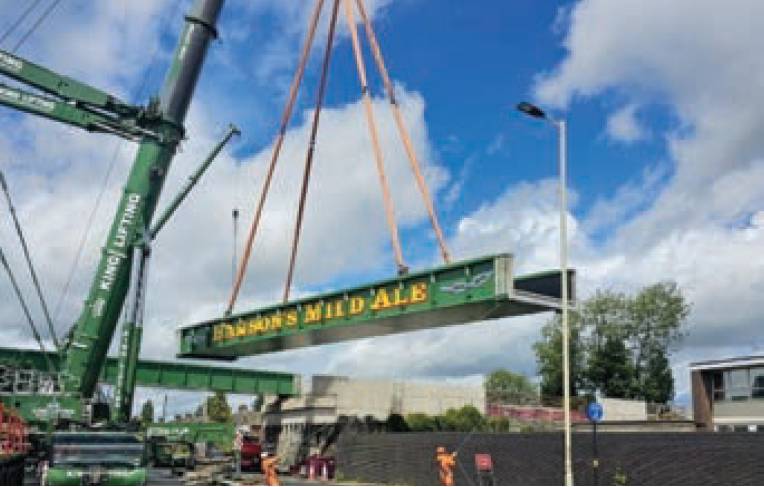
Installation of the second deck by crane.
Commenting on the new structure, they have observed how clear efforts have been made by the design team to ensure that a much-loved local landmark is re-established, with alterations to be fit for modern infrastructure needs.
The mayor further noted that the design team had recognised this structure “as a way to honour the region’s cultural history while delivering new modern infrastructure to better connect our communities”.
The close relationship between the Midland Metro Alliance (MMA) and Transport for West Midlands was vital to the success of the project.
The MMA was created in July 2016 to deliver extensions to the West Midlands Metro tram network, driven by the West Midlands Combined Authority (WMCA) to facilitate social and economic regeneration and improve connections across the region.
The alliance brings together Transport for West Midlands (the transport-arm of WMCA), a design consortium (including Egis, Tony Gee and Pell Frischmann), the lead construction specialist Colas Rail and its sub-alliance partners to deliver £1.3bn of new tram routes, initially over a 10-year programme.
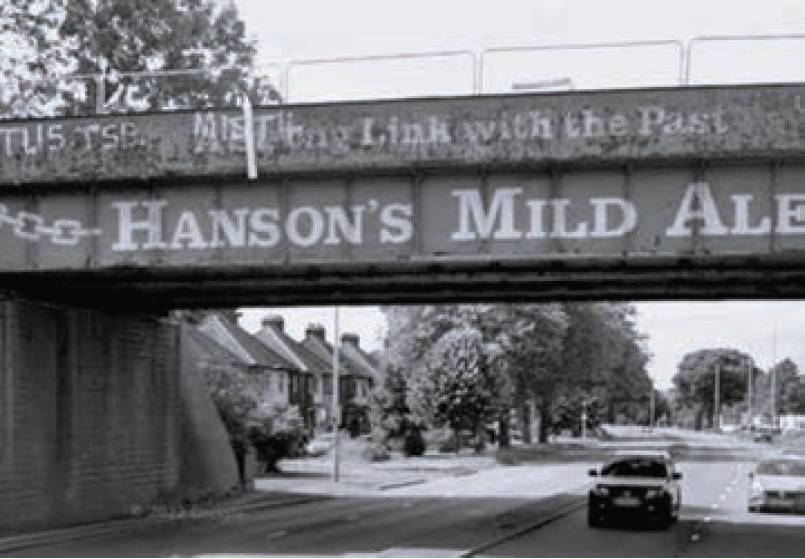
Elevation of the previous deck, prior to demolition.
Economic and social regeneration:
The WMCA established the alliance to boost the economy and create opportunities across the region by improving public transport links.
Improved connectivity:
The project aims to connect more people with work, education and leisure opportunities by extending the tram network to new areas, including Dudley, Brierley Hill, Digbeth and Wolverhampton.
Integrated public transport:
The alliance was formed to create a unified and efficient transport system for the future, supporting economic growth and reducing reliance on cars.
/CES - (90b378c6-7cd0-41e8-ad20-f8936d61b90e)/article/projecttimelineOctCES25.png)
Experience and expertise:
To deliver these large-scale projects, a partnership was formed between the public sector (WMCA) and private sector experts in design and construction to leverage their combined knowledge and skills, and ensuring that this knowledge and skills that were grown over the period of the programme were nurtured and not lost when individual extensions were opened to the public.
Plans and delivers extensions and enhancements: The core function of the alliance is to plan and deliver multiple tram extensions across the West Midlands. It does, however, deliver other tram related enhancements such as the massive modernisation of the depot in Wednesbury, a number of track replacement projects and power enhancements ensuring that the existing line remains resilient as the network grows.
Partnership: It functions as an alliance, though is not a legal entity, bringing together the WMCA, specialist designers, and construction firms who all share the pain and gain from delivery of these schemes.
Long-term vision: The alliance focuses on delivering a long-lasting legacy of improved infrastructure for the region.