
INVESTMENT IN BRIDGE INFRASTRUCTURE
Past president Barry Hiscox continues the Letter from America series
This month’s LFA identifies a number of significant bridge projects in the USA and the sizeable investment that has gone into their planning, construction, repair and development over the years.
The high-speed Acela Express eastern train from Boston to the capital Washington, although capable of speeds up to 150mph, was only able to achieve its optimum speed for a short stretch of less than 50 miles in Rhode Island/ Massachusetts during its 457-mile total journey. The principal reason for this was that the route was not on HS purpose-built tracks; there were 13 intermediate stops, including Baltimore, New York and Philadelphia and several choke points, resulting in an overall transit time of six hours and 36 minutes at an average speed of only 68mph – hardly high speed.
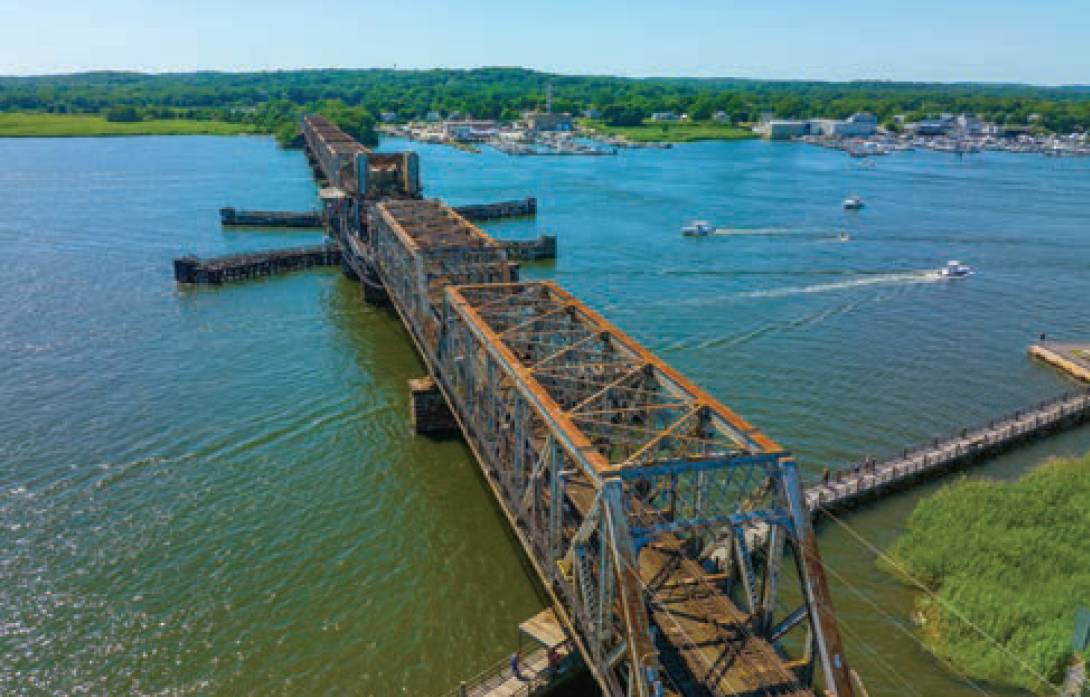
The current bridge over the Connecticut River, set to be replaced following investment.
One of the notorious choke points en route is the ancient rail bridge over the Connecticut River in Connecticut, built in 1907 and with a current speed restriction of 45mph.
However, the situation will be improved over the next couple of years with the now-approved plans for Amtrak to build a new adjacent railway bridge under an awarded construction contract with Tutor Perini and O&G Industries valued at $1.3bn. Construction was scheduled to commence in the late autumn of 2024.
The new two-track rail bridge will be situated immediately south of the existing structure and will feature modern track, signal, catenary, power and other essential infrastructure.
The design will allow for the increase in speed to 70mph, thereby enhancing reliability and reducing delays for Intercity services, the Connecticut Shore Line East Connection Line and freight operators along the North East Corridor (NEC), the busiest rail corridor in the USA.
But perhaps most importantly, it will eliminate current delays to the Acela Express at this location, improving the overall transit time of the express. This new $1.3bn structure is one of the projects under the Biden/Harris plan to improve and increase infrastructure in the USA.
Financing for the bridge is as follows:
- Infrastructure and Jobs Act: $827m
- Amtrak: $148m
- State of Connecticut: $58m
- Total: $1.3bn
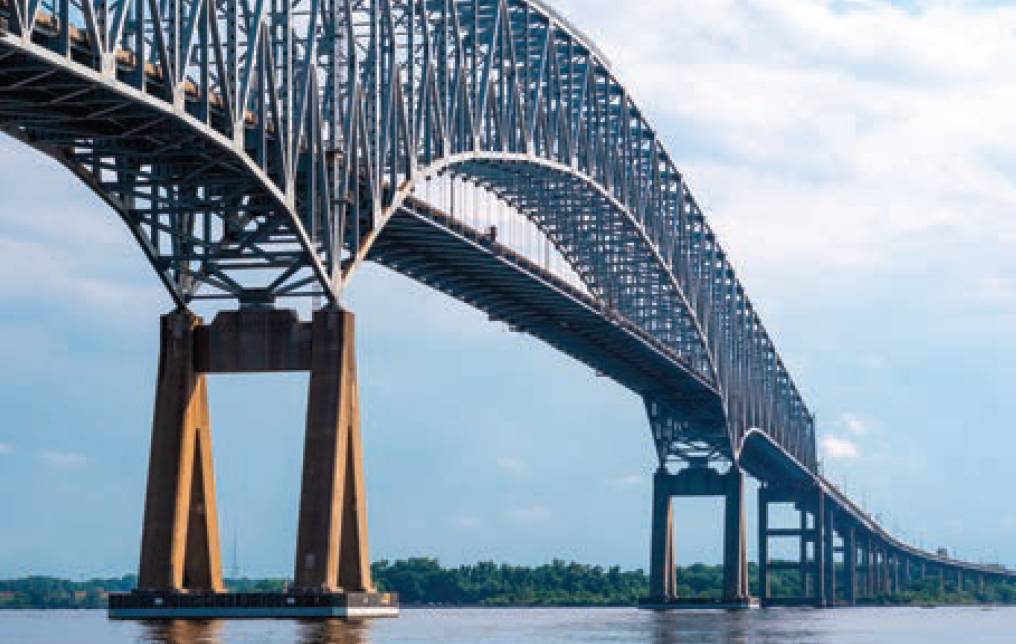
Francis Scott Key Bridge, Baltimore, Maryland.
No doubt you will have heard of the ship collision and catastrophic collapse of the main span of this bridge when, at 1.25am on 26 March 2024, a large container ship (the DALI) struck one of its piers, killing six workers and damaging beyond repair the steel arch continuous through truss bridge spanning the lower Patapsco River and outer Baltimore Harbour. The cause of the collision was the loss of steering of the ship due to loss of power, faults and mishandling.
Originally opened in 1977, its main span of 1,200ft (366m) was the third longest of any continuous truss in the world and carried an approximate average of 11.5m vehicles annually, but on 26 March 2024 suddenly became unavailable.
The collapse blocked the Patapsco shipping channel, halting passenger and cargo to the port of Baltimore, resulting in estimated economic losses of $15m per day and incurring multibillion-dollar losses for damages, business disruption and liability claims.
Three temporary channels were opened by 20th April 2024, allowing only 15% of pre-collapse shipping to pass. A temporary deep-draft channel was opened on 25 April 2024, allowing some larger ships to enter/leave the port, but was closed again on 29 April 2024 to enable salvage crews to resume removal of bridge wreckage. Within hours of the collapse, President Biden announced that a federal grant would pay for the entire cost of reconstructing the bridge by autumn of 2028 at an estimated cost of $1.7- $1.9bn.
On 23 July 2024 the Maryland Transport Authority (MDTA) and the Maryland Department of Transportation State Highway Administration (SMA) received federal approvals for the reconstruction of the bridge – The Key Bridge Rebuild – with no increase in traffic lane capacity of the original bridge.
The replacement bridge will have a minimum vertical clearance of 230ft – the 800ft wide authorised Fort McHenry Navigation Channel to accommodate clearance for increased size ships and a minimum horizontal clearance of 1,100ft. There is to be no additional land use.
Webuild, with its US subsidiary Lane, unveiled a proposal for the new bridge: A cable-stayed bridge design developed in collaboration with the Massachusetts Institute of Technology (MIT) by Professor Carlo Ratti, professor of urban technologies and planning director.
The design proposes to increase the span from 1,200 to 2,230ft, enabling the primary support pillars to be constructed in shallow water away from the navigation channel used by any large vessels. It would also be environmentally friendly, as it would not disturb the ecosystem of the Patapsco River. Such a bridge would also make provision for cycle/pedestrian lanes.
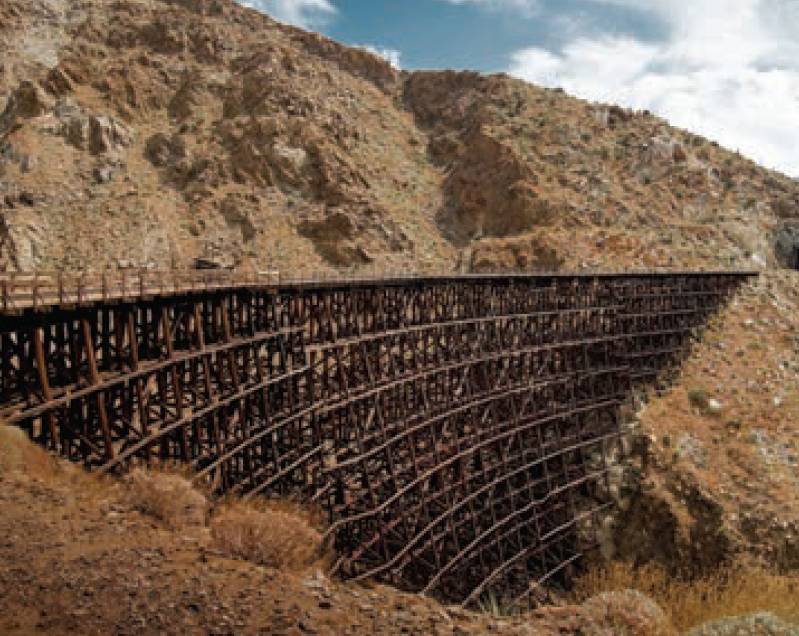
The Goat Canyon Trestle Bridge, California.
This trestle railroad bridge was built entirely out of Redwood timber without any nails, due to the extreme temperatures experienced in the Colorado Desert and through the Jacumba Mountains.
Originally, the route of the San Diego and Arizona Eastern Railroad, connecting San Diego with Yuma, was built at the urging of President Theodore Roosevelt, with construction commencing in 1907 through what was then considered impossible terrain.
The route was completed in 1919, providing a connection to the Southern Pacific Railroad. Unfortunately, this new railroad route was fraught with problems of landslides and a tunnel collapse due to an earthquake in 1932 – along its route was the Campo Creek Viaduct, a significant bridge measuring at 600ft long that stood 200ft above the ground. The collapse caused the building of the Goat Canyon Trestle Bridge in 1932/1933, leading to a realignment of the railroad route.
The Goat Canyon Trestle Bridge, at the southern end of Anza-Borrego National Park, is only 15 miles north of the Mexican border. Although obscure, I have chosen this historic structure because:
- This 100% timber trestle bridge is the longest freestanding trestle in the world at 597 – 750ft (182 – 229m).
- The bridge is built entirely of redwood timber of the same type used for railtrack sleepers.
- No nails were used in its construction because of the extremely high temperature climatic conditions.
- The trestle was built on a 14-degree curve to counteract the effects of high winds.
- Although approaching 100 years old, it is still in good condition and used occasionally, although the route for public rail transportation primarily ceased in 2008.
The bridge is only accessible by a six-mile round-trip hike. Access should only be attempted by experienced hikers and then not without a lot of research, a GPS, a four-wheel drive vehicle to the trail head, mental preparation and most certainly not if it is hot! The uniquely constructed timber components of the bridge were built in the valley floor and hoisted into position. After the second world war, the railway started to struggle because of increasing car transportation, such that in 1951 passenger service came to a screeching halt.
Some freight trains still took advantage of the route over the colossal Goat Canyon Trestle, until, in 1979, Hurricane Kathleen devastated the entire area, damaging the bridge and surrounding tracks, which were repaired in 1981. A further tunnel collapse in 1983 caused abandonment of tracks and bridge for the next 10 years.
In 2003, the decision was made to repair the rails; in 2004, the Pacific Southwest Railway Museum started giving rides to the bridge, until the collapse of Tunnel Number Six paused train activity yet again. In 2018, there were again talks about rebuilding the railroad.