
THE HISTORY AND IMPORTANCE OF CHATTANOOGA, TENNESSEE
Past president Barry Hiscox continues the Letter from America series
For this month’s LFA I’m featuring Chattanooga in Tennessee, which I visited recently to discover its very interesting historical background, one that, in essence, has had a significant influence on where we are today as the United States.
Home to 184,000 people, the city ranks fourth in population in Tennessee, 142nd in the USA, and is currently the seat of Hamilton County. Situated on a bend in the Tennessee River and near the border of Alabama, it has made an important contribution to the development of communications and has played its part in some significant historic events.
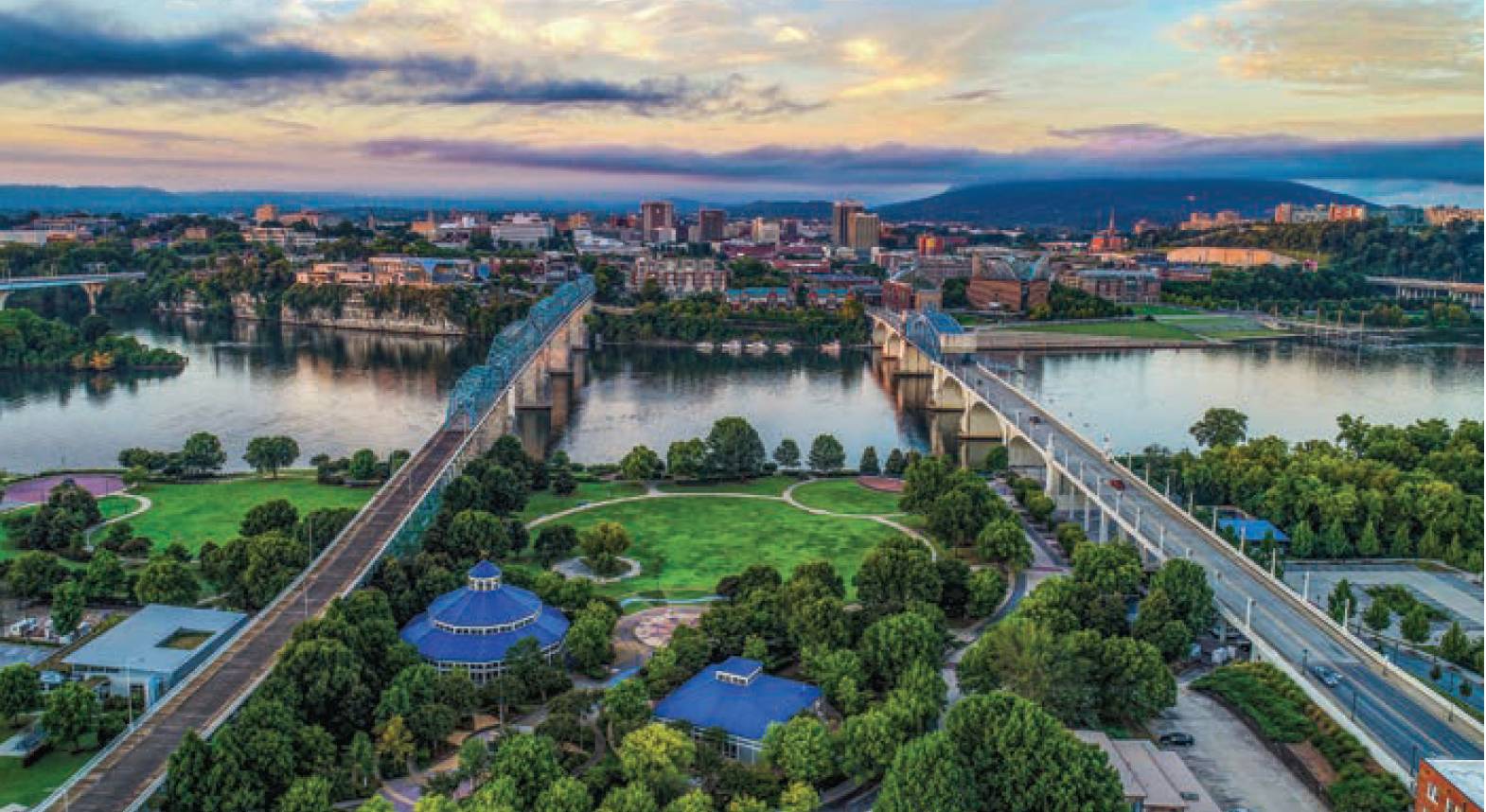
The name of Chattanooga was established when the community of Ross’s Landing was reincorporated in 1839, where it remained as a relatively small settlement until the arrival of the Western and Atlantic railroad during 1850, offering through service to Atlanta, Georgia. The new railroad, along with water access, witnessed the city’s expansion into an important commercial hub.
The city is at an elevation of 676ft (206m), occupying areas of 142 square miles of land with eight square miles of water and played an important part in the events of the American Civil War between the union (north) and confederate (south) forces. Chattanooga was a crucial city in the Civil War due to the multiple railroads that converge there. As a vital railroad hub, it connected 50% of confederacy armaments (other centres were located in Atlanta, Augusta, Columbus and Macan), transferring raw materials to processing plants for production of small arms munitions.
During the Chickamauga campaign, union artillery bombarded Chattanooga, occupying it on 9 September 1863. The start of the Battle for Chattanooga, 23 November 1863 was when major general Ulysses S. Grant reinforced troops in Chattanooga and advanced against the besieging confederates.
This was followed by the Battle of Lookout Mountain on 24 November, which saw the confederates driven from the mountain, with Grant’s army routing the confederates in the Battle of Missionary Ridge on 25 November.
These battles were some of the defining moments of the Civil War, turning it in favour of the union army. The presence of the railroads ultimately allowed the city to grow into one of south eastern USA’s largest industrial hubs, today involving automotive, advanced manufacturing, food and beverage production, healthcare, tourism and branch office and corporate headquarters.
The presence of the railroads ultimately allowed the city to grow into one of south eastern USA’s largest industrial hubs, today involving automotive, advanced manufacturing, food and beverage production, healthcare, tourism and branch office and corporate headquarters.
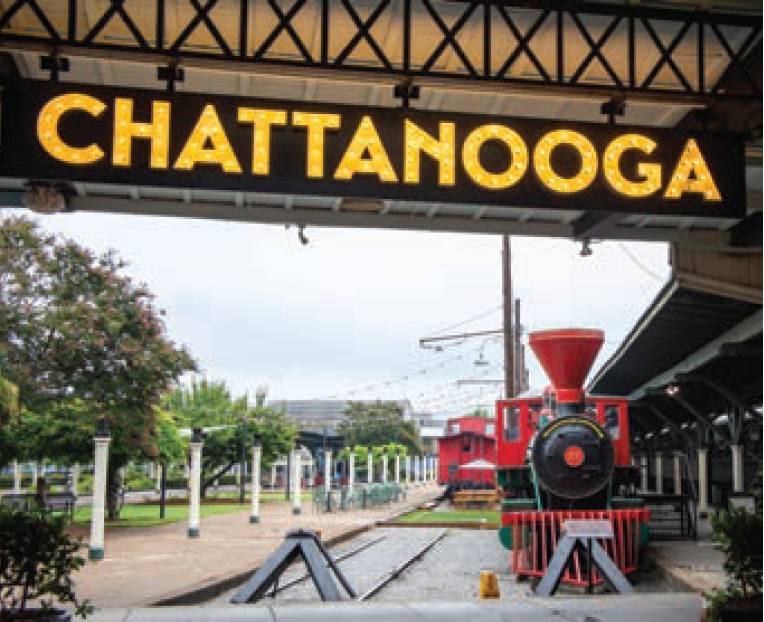
The Terminus Railroad building, an architectural highlight, is listed on The National Register of Historic Buildings and was originally a hotel in true Victorian style, acquired by the Southern Railway in 1905 and subsequently reopened as a rail station in 1909, at its peak handling up to 50 trains per day.
Although the Terminus Station was closed in 1970 and converted and reopened in 1973 as a modern tourist attraction and hotel, to this day Chattanooga remains a transit hub, served by multiple interstate (I road) highways and railroad lines, situated 180km southwest of Knoxville Tennessee, 216km northeast of Nashville Tennessee, 164km east northeast of Huntsville Alabama and 237km northeast of Birmingham Alabama.
Divided by the Tennessee River, the city is at the transition between the Ridge and Valley Appalachian and the Cumberland Plateau and is officially named The Scenic City. With one of its nicknames, Gig City, it claims to have the fastest internet service in the Western Hemisphere and is internationally known from the 1941 hit song Chattanooga Choo Choo by the famous Glenn Miller Orchestra.
The name of the city may be derived from either the Muskegon word for rock or the Creek Indian word Chat-to-to-noog-gee, meaning ‘rock rising to a point’. Because of a history of major flooding, hallmarked by the largest in local history in 1867 when the river peaked at 58ft above normal, the Tennessee Valley Authority (TVA) was eventually created by Congress in 1933.
Since completion of the resultant reservoir system, the height of the flood was contained at a maximum of 37ft (11m) above normal in 1973. Chattanooga was a major player in the design of the TVA system.
A more recent claim to fame for Chattanooga is the largest vehicle production plant of Volkswagen in North America, built from scratch, commencing 2010 with its own bespoke rail link for vehicle delivery. It initially opened for production for the recently expired US Passat model, but now producing the Atlas, the Atlas Cross Sport and the relatively recent ID.4 all-electric ‘car of the future’. The presence of this major manufacturer has had a significant beneficial impact upon the economy of Chattanooga and its surrounding region, reducing the unemployment rate in the area to 3.5% from a record-breaking level exceeding 10% in 2009.
Current employment exceeds 5,500 and the facility occupies 3,803,466ft2 under roof of an overall parcel of land amounting to 1,400 acres (6km2 ) of the Enterprise South Industrial Park in Eastern Chattanooga. Production of vehicles during 2023 was 175,000, namely the ID.4, Atlas and Atlas Cross Sport Models.
As a final highlight from my trip (for the time being), I’m featuring yet another achievement of engineering, dating back to the parallel Victorian era in Britain. This funicular railway opened as long ago as 1895, to transport sightseers to the top of Lookout Mountain situated across the Tennesee River Valley from Chattanooga.
The ride from the lower to the upper stations of the route is one mile along a single-track funicular railway and at a steep gradient of maximum 72.7%, rising 1,450ft.
The route starts at the historic St. Elmo neighborhood of Chattanooga and there is a passing bay at half way.
Technically, the railway is a 4’8.5” standard gauge inclined plane funicular railway. One of the cars has flanges on the inside of its wheels, the other on the outside, allowing the cars to pass midway with no moving parts in the track turnouts.
Both cars have self-contained emergency brakes. Originally powered by steam produced by huge wood-burning steam engines, it then progressed to coal, eventually using electric power when it was introduced after 1911.
The incline is now driven by two 100-horsepower motors, with the present incline cars having been installed in 1987.
Passengers have been carried up and down the mountain in complete safety since the funicular railway first went into operation before the turn of the century.
John T. Crass formed the Lookout Mountain Incline Mountain Railway Company, building this short fast incline up the steepest part of the mountain by 16 November 1895.
Its success closed down competitors by 1900 and continues to this day. It was originally built to gain access to the newly built hotel at the summit and is now operated by Chattanooga Area Regional Transportation Authority, the area’s public transport agency.
Two cars operate regularly throughout the day, counterbalanced on the propulsion cable system, as they travel from lower to upper stations.
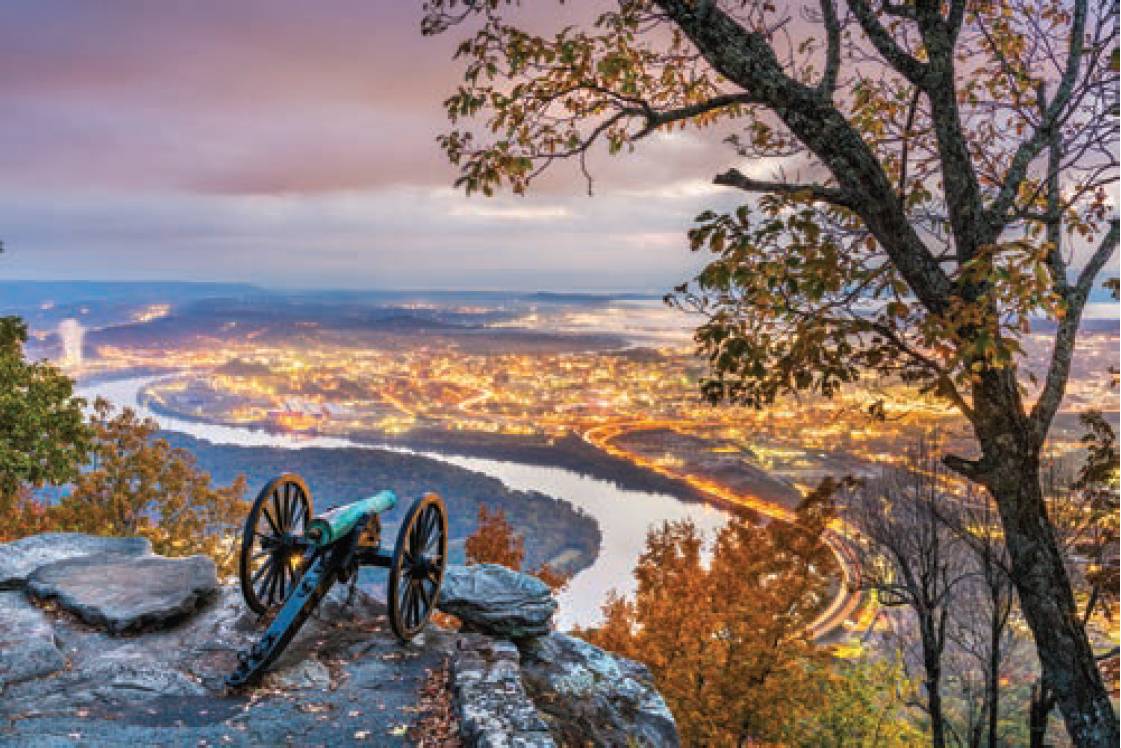
It is advertised as ‘the world’s steepest passenger railway’ and is well worth the trip to the top to see the astounding view from the appropriately named Lookout Mountain (pictured, left).